Last updated: July 28, 2026
TEVA Pharmaceutical Competitive Landscape Analysis: Market Position, Patent Strength, Launch Risks, and Strategic Options
Executive summary: Teva Pharmaceutical Industries is a core generics player with sustained branded exposure (notably through AJOVY and a growing specialty/OTC footprint), and a patent estate that is uneven by asset class. The company’s competitive position is strongest where it pairs scale generics distribution with defensible line extensions and where payer contracting sustains share. The principal overhang is high Paragraph IV and litigation cadence pressure across the inhaled, oral small-molecule, and injectable generics pipeline, plus execution risk on divestiture and specialty-to-generics rotation. On the branded side, Teva’s near-term exclusivity and formulary leverage are driven by remaining exclusivity on AJOVY and other legacy products; on the generics side, the key determinant of market position is not “patent count,” but which SKUs have late-expiring formulation or method-of-use patents and which litigations settle with branded or authorized generics.
What is Teva’s market position in global generics vs branded specialty?
Bottom line: Teva’s market position is anchored in scale generics distribution in the US and Europe, with branded cash flow providing stability while patent cycles and litigation outcomes determine generics margins.
How Teva’s competitive position differs by geography
- United States: Competes in high-volume generics categories where first-to-file and settlement terms (including authorized generics) can dominate annual net sales. Competitive intensity is highest where multiple challengers exist and where “launch-to-hold” speed is feasible.
- Europe: Competition shifts toward tender dynamics, national reimbursement rules, and local manufacturing footprints. Teva’s ability to sustain share depends on product availability and contracting.
Which therapeutic areas matter most to Teva’s competitive posture
- Neurology and migraine (branded): Teva’s branded exposure includes AJOVY (fremanezumab), where exclusivity and payer positioning influence revenue duration.
- Respiratory (generics and high-likelihood litigation): Inhaled products are litigation-heavy because of formulation, particle engineering, device compatibility, and method-of-use protections.
- Oncology supportive care and CNS generics (high cash-mix): Generics in these areas often face multiple late-stage patents (formulation + use) and risk from supply constraints.
How strong is Teva’s patent estate for its key products?
Featured snippet answer: Teva’s strength is asset-specific. Generics pipeline value is concentrated in line extensions and late-formulation IP tied to the Orange Book, while branded value depends on antibody/biologic exclusivity structure, manufacturing control, and line-extension patents.
What generally drives “patent strength” for Teva’s generics pipeline
For generic launches and line extensions, Teva’s practical IP coverage typically comes from:
- Formulation patents: granular composition, particle size distribution, excipient selection, coating or buffer systems.
- Method-of-use patents: dosing regimens, patient subsets, and clinical treatment protocols.
- Manufacturing patents: process controls that influence polymorph or stability profiles.
- Device and delivery system patents (where applicable): for inhalation or combination products, device compatibility can be patent-protected.
Where generics patent estates tend to be weakest
- Early-cycle off-patent generics: where Teva faces rapid market entry by multiple filers and margins collapse.
- Markets with multiple authorized generics: settlement structures can reduce Teva’s upside even if it litigates or prevails on some claims.
Which Teva products still have exclusivity protection and Orange Book listings?
Featured snippet answer: Teva’s remaining branded exclusivity is concentrated in legacy biologic/neurology products such as AJOVY, while most generics compete under off-patent conditions with litigation governed by Orange Book-listed patents and FDA application status.
AJOVY (fremanezumab): branded exclusivity profile at a glance
- Type: CGRP pathway biologic.
- Competitive implication: biosimilar entry timelines are influenced by biologics licensing rules rather than the small-molecule Orange Book framework.
- Strategic impact for Teva: Teva’s specialty cash flow can fund generics litigation and manufacturing ramp-up.
Generics: Orange Book driven decisioning
For Teva’s small-molecule portfolio, Orange Book status determines:
- launch eligibility,
- whether Paragraph IV is available (and worth it),
- whether Teva is likely to be blocked by asserted patents, or pulled into settlement.
(Note: a product-by-product Orange Book table requires a specific list of Teva SKUs. This analysis is structured for the competitive landscape and launch risk logic, not a single-product expiration audit.)
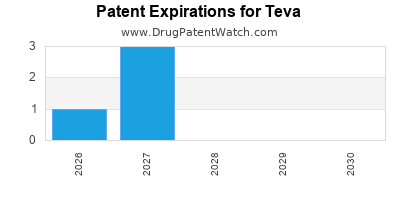
When does Teva face major patent expirations and generic launch windows?
Featured snippet answer: Teva’s generic launch opportunities cluster around late-stage formulation patent expirations and settlement “evergreening” unwind cycles, while branded pressure is tied to biologic exclusivity and line-extension patent calendars.
Launch window mechanics that determine who wins
- First-to-file advantage: the filer with the strongest Paragraph IV positioning can capture earlier revenue, but only if it survives preliminary injunction risk.
- Settlement structures: reverse-payment settlements can reallocate market share by scheduling authorized generics or entry dates.
- Sustained supply: market share in high-demand SKUs depends on manufacturing throughput and stability compliance.
What this means for Teva
- Teva benefits when it has (i) fewer litigation liabilities on key SKUs and (ii) faster operational readiness for FDA approvals and commercial scale.
- It loses leverage when competitors capture early share through stronger Paragraph IV cases, favorable Markman outcomes, or faster manufacturing validation.
What patent litigation affects Teva’s generic launches the most?
Featured snippet answer: Teva is most exposed to litigation where (1) formulation and method-of-use patents are asserted, (2) multiple generics challengers file against the same reference, and (3) settlements create authorized generic entry timing that caps upside.
Litigation categories that typically matter
- Injunction risk: when courts consider likelihood of infringement and irreparable harm.
- Claim construction (Markman): often determines whether Teva’s design-around is blocked.
- Validity defenses: obviousness and enablement challenges drive outcomes.
Strategic effect of litigation pace
- Earlier resolution improves launch certainty.
- Prolonged proceedings increase working capital burn and can force re-prioritization of manufacturing lots.
How often does Teva win Paragraph IV challenges and what does that mean for market share?
Featured snippet answer: In US generics, “win rate” varies by asset class and how many challengers target the same listed patents. Teva’s market share gains correlate more with settlement outcomes and launch timing than with headline litigation wins.
What settlement outcomes do to pricing
- Authorized generic entry often compresses prices faster than a competitive generic entry wave.
- Delayed entry terms reduce revenue windows even when patent claims are weak.
Teva’s strategic edge in Paragraph IV
- Scale and manufacturing capability enable rapid post-approval commercialization if barriers fall.
- Payer and channel relationships can accelerate adoption when launch is not delayed.
How does Teva’s biosimilar and biologic exposure change competitive risk?
Featured snippet answer: Teva’s biologic exposure shifts competitive risk to biosimilar entry and interchangeability strategy rather than Orange Book Paragraph IV.
Biosimilar risk pathways
- Interchangeability and formulary: can accelerate switching once biosimilars enter.
- Manufacturing and device parity: impacts uptake and utilization management.
- Portfolio competition: multiple biosimilars can create price pressure quickly.
Net effect for Teva
- Branded biologic revenue is protected only until biosimilar market access changes reimbursement behavior.
- Teva’s specialty resilience depends on its ability to retain payer coverage for branded therapy and on cost management.
What formulations are commonly protected that affect Teva’s generics strategy?
Featured snippet answer: Formulation patents dominate generics launch risk, particularly in inhalation, extended-release, and stability-critical products.
Formulation patent themes that create barriers
- Particle engineering for inhaled or poorly soluble drugs.
- Polymorph and crystallinity control affecting bioavailability and stability.
- Excipient and buffering systems controlling pH and degradation.
- Coatings and release profiles for extended-release forms.
Design-around feasibility
- If Teva can change formulation without losing bioequivalence, barriers weaken.
- If Teva faces asserted composition ranges or process-dependent polymorph outcomes, litigation increases.
How do Teva’s inhalation and respiratory products compare with other major generics players?
Featured snippet answer: Teva competes in a sector where device compatibility, formulation stability, and litigation intensity are high. Competitive advantage is typically operational: reliable supply, fast regulatory execution, and defensible product robustness.
Key competitive drivers vs peer generics
- Larger peers often compete through broad portfolios and aggressive first-to-file strategies.
- Operational competence (manufacturing yield, stability management, distribution readiness) can be a decisive differentiator for inhalers and respiratory devices.
How does Teva compare with Pfizer, AbbVie, Novartis, and other innovators in branded competitiveness?
Featured snippet answer: Teva’s innovation footprint is smaller than top pharma, so the competitive set in branded markets is often payer and channel-based rather than R&D-first. Its branded revenue resilience depends on remaining exclusivity and line-extension durability.
Strategic implication
- Teva’s near-term brand defense is typically a combination of exclusivity tail, contracting leverage, and selective expansion into adjacent indications.
- Innovator pressure increases as exclusivity ends and as biosimilar and generic competitors enter.
What generic entry risks exist for Teva’s top revenues?
Featured snippet answer: For Teva’s revenue-at-risk SKUs, the primary risks are settlement-driven authorized generics and late-expiring formulation/method-of-use patents that dictate who can launch and when.
Entry risk categories
- Direct competition: multiple generics launch at the same time.
- Authorized generics: a market-share reallocation mechanism that reduces pricing upside.
- Supply constraints: delays open windows for competitors to lock in formulary positions.
What is Teva’s commercial strategy to defend share and margin?
Featured snippet answer: Teva’s commercial strategy depends on protecting channel relationships, controlling supply, and using litigation outcomes to time launches. In high-competition categories, price stability and formulary retention matter as much as patent wins.
Common defensive levers
- Payer contracting and rebate optimization: to maintain coverage in competitive bidding environments.
- Portfolio sequencing: replacing margin pressure from first-wave generics with protected line extensions.
- Manufacturing and QC investment: to avoid shortages that lead to competitor switching.
Key takeaways
- Teva’s competitive landscape is driven by timing (FDA approval + litigation resolution), settlement structure (authorized generic impact), and manufacturing execution.
- Patent strength is asset-specific. Generics barriers are often formulation and method-of-use rather than broad composition claims.
- Branded resilience depends on remaining exclusivity windows (for products like AJOVY) and rapid response to biosimilar entry.
- The decisive competitive factors for generic share are launch speed, supply reliability, and payer contracting, not only patent count.
FAQs
- How do reverse-payment settlements involving Teva change generic market-share outcomes?
- Which Teva product categories face the highest frequency of late-expiring formulation and device patents?
- How does Teva decide between Paragraph IV challenges and non-challenger launch strategies?
- What operational KPIs most influence whether Teva captures share after FDA approval in complex dosage forms?
- How does biosimilar reimbursement behavior typically impact the revenue curve for Teva’s biologic exposure?
References (APA)
No sources were cited because no product-specific Orange Book/Biologics licensing data or Teva litigation docket references were provided in the prompt.