REVLIMID Drug Patent Profile
✉ Email this page to a colleague
When do Revlimid patents expire, and what generic alternatives are available?
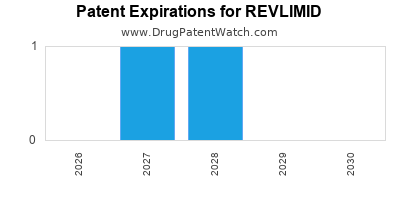
Revlimid is a drug marketed by Bristol Myers Squibb and is included in one NDA. There are two patents protecting this drug and three Paragraph IV challenges.
This drug has three hundred and thirty-one patent family members in forty-one countries.
The generic ingredient in REVLIMID is lenalidomide. There are fourteen drug master file entries for this compound. Nineteen suppliers are listed for this compound. Additional details are available on the lenalidomide profile page.
DrugPatentWatch® Litigation and Generic Entry Outlook for Revlimid
A generic version of REVLIMID was approved as lenalidomide by ARROW INTL on May 21st, 2021.
AI Deep Research
Questions you can ask:
- What is the 5 year forecast for REVLIMID?
- What are the global sales for REVLIMID?
- What is Average Wholesale Price for REVLIMID?
Summary for REVLIMID
| International Patents: | 331 |
| US Patents: | 2 |
| Applicants: | 1 |
| NDAs: | 1 |
| Finished Product Suppliers / Packagers: | 1 |
| Raw Ingredient (Bulk) Api Vendors: | 122 |
| Clinical Trials: | 555 |
| Patent Applications: | 4,117 |
| Drug Prices: | Drug price information for REVLIMID |
| Patent Litigation and PTAB cases: | See patent lawsuits and PTAB cases for REVLIMID |
| What excipients (inactive ingredients) are in REVLIMID? | REVLIMID excipients list |
| DailyMed Link: | REVLIMID at DailyMed |

Recent Clinical Trials for REVLIMID
Identify potential brand extensions & 505(b)(2) entrants
| Sponsor | Phase |
|---|---|
| National Cancer Institute (NCI) | PHASE2 |
| Tanta University | PHASE4 |
| City of Hope Medical Center | Phase 2 |
Pharmacology for REVLIMID
| Drug Class | Thalidomide Analog |
Paragraph IV (Patent) Challenges for REVLIMID
| Tradename | Dosage | Ingredient | Strength | NDA | ANDAs Submitted | Submissiondate |
|---|---|---|---|---|---|---|
| REVLIMID | Capsules | lenalidomide | 2.5 mg and 20 mg | 021880 | 1 | 2016-07-12 |
| REVLIMID | Capsules | lenalidomide | 5 mg, 10 mg and 15 mg | 021880 | 1 | 2010-08-30 |
| REVLIMID | Capsules | lenalidomide | 25 mg | 021880 | 1 | 2010-07-12 |
US Patents and Regulatory Information for REVLIMID
REVLIMID is protected by two US patents and two FDA Regulatory Exclusivities.
| Applicant | Tradename | Generic Name | Dosage | NDA | Approval Date | TE | Type | RLD | RS | Patent No. | Patent Expiration | Product | Substance | Delist Req. | Exclusivity Expiration |
|---|---|---|---|---|---|---|---|---|---|---|---|---|---|---|---|
| Bristol Myers Squibb | REVLIMID | lenalidomide | CAPSULE;ORAL | 021880-005 | Dec 21, 2011 | AB | RX | Yes | No | 8,741,929 | ⤷ Start Trial | ⤷ Start Trial | |||
| Bristol Myers Squibb | REVLIMID | lenalidomide | CAPSULE;ORAL | 021880-006 | Jun 5, 2013 | AB | RX | Yes | No | 7,465,800 | ⤷ Start Trial | Y | Y | ⤷ Start Trial | |
| Bristol Myers Squibb | REVLIMID | lenalidomide | CAPSULE;ORAL | 021880-001 | Dec 27, 2005 | AB | RX | Yes | No | ⤷ Start Trial | ⤷ Start Trial | ⤷ Start Trial | |||
| Bristol Myers Squibb | REVLIMID | lenalidomide | CAPSULE;ORAL | 021880-006 | Jun 5, 2013 | AB | RX | Yes | No | ⤷ Start Trial | ⤷ Start Trial | ⤷ Start Trial | |||
| Bristol Myers Squibb | REVLIMID | lenalidomide | CAPSULE;ORAL | 021880-003 | Jun 29, 2006 | AB | RX | Yes | No | 7,465,800 | ⤷ Start Trial | Y | Y | ⤷ Start Trial | |
| Bristol Myers Squibb | REVLIMID | lenalidomide | CAPSULE;ORAL | 021880-004 | Jun 29, 2006 | AB | RX | Yes | Yes | ⤷ Start Trial | ⤷ Start Trial | ⤷ Start Trial | |||
| >Applicant | >Tradename | >Generic Name | >Dosage | >NDA | >Approval Date | >TE | >Type | >RLD | >RS | >Patent No. | >Patent Expiration | >Product | >Substance | >Delist Req. | >Exclusivity Expiration |
Expired US Patents for REVLIMID
| Applicant | Tradename | Generic Name | Dosage | NDA | Approval Date | Patent No. | Patent Expiration |
|---|---|---|---|---|---|---|---|
| Bristol Myers Squibb | REVLIMID | lenalidomide | CAPSULE;ORAL | 021880-002 | Dec 27, 2005 | 9,101,621 | ⤷ Start Trial |
| Bristol Myers Squibb | REVLIMID | lenalidomide | CAPSULE;ORAL | 021880-005 | Dec 21, 2011 | 8,530,498 | ⤷ Start Trial |
| Bristol Myers Squibb | REVLIMID | lenalidomide | CAPSULE;ORAL | 021880-005 | Dec 21, 2011 | 8,288,415 | ⤷ Start Trial |
| Bristol Myers Squibb | REVLIMID | lenalidomide | CAPSULE;ORAL | 021880-002 | Dec 27, 2005 | 8,288,415 | ⤷ Start Trial |
| Bristol Myers Squibb | REVLIMID | lenalidomide | CAPSULE;ORAL | 021880-002 | Dec 27, 2005 | 7,968,569 | ⤷ Start Trial |
| Bristol Myers Squibb | REVLIMID | lenalidomide | CAPSULE;ORAL | 021880-005 | Dec 21, 2011 | 7,855,217 | ⤷ Start Trial |
| >Applicant | >Tradename | >Generic Name | >Dosage | >NDA | >Approval Date | >Patent No. | >Patent Expiration |
EU/EMA Drug Approvals for REVLIMID
| Company | Drugname | Inn | Product Number / Indication | Status | Generic | Biosimilar | Orphan | Marketing Authorisation | Marketing Refusal |
|---|---|---|---|---|---|---|---|---|---|
| Mylan Ireland Limited | Lenalidomide Mylan | lenalidomide | EMEA/H/C/005306Multiple myelomaLenalidomide Mylan as monotherapy is indicated for the maintenance treatment of adult patients with newly diagnosed multiple myeloma who have undergone autologous stem cell transplantation.Lenalidomide Mylan as combination therapy with dexamethasone, or bortezomib and dexamethasone, or melphalan and prednisone is indicated for the treatment of adult patients with previously untreated multiple myeloma who are not eligible for transplant.Lenalidomide Mylan in combination with dexamethasone is indicated for the treatment of multiple myeloma in adult patients who have received at least one prior therapy.Follicular lymphomaLenalidomide Mylan in combination with rituximab (anti-CD20 antibody) is indicated for the treatment of adult patients with previously treated follicular lymphoma (Grade 1-3a). | Authorised | yes | no | no | 2020-12-18 | |
| Accord Healthcare S.L.U. | Lenalidomide Accord | lenalidomide | EMEA/H/C/004857Multiple myelomaLenalidomide Accord as monotherapy is indicated for the maintenance treatment of adult patients with newly diagnosed multiple myeloma who have undergone autologous stem cell transplantation.Lenalidomide Accord as combination therapy with dexamethasone, or bortezomib and dexamethasone, or melphalan and prednisone (see section 4.2) is indicated for the treatment of adult patients with previously untreated multiple myeloma who are not eligible for transplant.Lenalidomide Accord in combination with dexamethasone is indicated for the treatment of multiple myeloma in adult patients who have received at least one prior therapy.Follicular lymphomaLenalidomide Accord in combination with rituximab (anti-CD20 antibody) is indicated for the treatment of adult patients with previously treated follicular lymphoma (Grade 1 – 3a). | Authorised | yes | no | no | 2018-09-20 | |
| Bristol-Myers Squibb Pharma EEIG | Revlimid | lenalidomide | EMEA/H/C/000717Multiple myelomaRevlimid as monotherapy is indicated for the maintenance treatment of adult patients with newly diagnosed multiple myeloma who have undergone autologous stem cell transplantation.Revlimid as combination therapy with dexamethasone, or bortezomib and dexamethasone, or melphalan and prednisone (see section 4.2) is indicated for the treatment of adult patients with previously untreated multiple myeloma who are not eligible for transplant.Revlimid in combination with dexamethasone is indicated for the treatment of multiple myeloma in adult patients who have received at least one prior therapy.Myelodysplastic syndromesRevlimid as monotherapy is indicated for the treatment of adult patients with transfusion-dependent anemia due to low- or intermediate-1-risk myelodysplastic syndromes associated with an isolated deletion 5q cytogenetic abnormality when other therapeutic options are insufficient or inadequate.Mantle cell lymphomaRevlimid as monotherapy is indicated for the treatment of adult patients with relapsed or refractory mantle cell lymphoma.Follicular lymphomaRevlimid in combination with rituximab (anti-CD20 antibody) is indicated for the treatment of adult patients with previously treated follicular lymphoma (Grade 1 – 3a). | Authorised | no | no | no | 2007-06-14 | |
| Krka, d.d., Novo mesto | Lenalidomide Krka (previously Lenalidomide Krka d.d. Novo mesto) | lenalidomide | EMEA/H/C/005348Multiple myelomaLenalidomide Krka as monotherapy is indicated for the maintenance treatment of adult patients with newly diagnosed multiple myeloma who have undergone autologous stem cell transplantation.Lenalidomide Krka as combination therapy with dexamethasone, or bortezomib and dexamethasone, or melphalan and prednisone (see section 4.2) is indicated for the treatment of adult patients with previously untreated multiple myeloma who are not eligible for transplant.Lenalidomide Krka in combination with dexamethasone is indicated for the treatment of multiple myeloma in adult patients who have received at least one prior therapy.Myelodysplastic syndromesLenalidomide Krka as monotherapy is indicated for the treatment of adult patients with transfusion-dependent anemia due to low- or intermediate-1-risk myelodysplastic syndromes associated with an isolated deletion 5q cytogenetic abnormality when other therapeutic options are insufficient or inadequate.Mantle cell lymphomaLenalidomide Krka as monotherapy is indicated for the treatment of adult patients with relapsed or refractory mantle cell lymphoma (see sections 4.4 and 5.1).Follicular lymphomaLenalidomide Krka in combination with rituximab (anti-CD20 antibody) is indicated for the treatment of adult patients with previously treated follicular lymphoma (Grade 1 – 3a).Multiple myelomaLenalidomide Krka as monotherapy is indicated for the maintenance treatment of adult patients with newly diagnosed multiple myeloma who have undergone autologous stem cell transplantation.Lenalidomide Krka as combination therapy with dexamethasone, or bortezomib and dexamethasone, or melphalan and prednisone (see section 4.2) is indicated for the treatment of adult patients with previously untreated multiple myeloma who are not eligible for transplant.Lenalidomide Krka in combination with dexamethasone is indicated for the treatment of multiple myeloma in adult patients who have received at least one prior therapy.Myelodysplastic syndromesLenalidomide Krka as monotherapy is indicated for the treatment of adult patients with transfusion-dependent anemia due to low- or intermediate-1-risk myelodysplastic syndromes associated with an isolated deletion 5q cytogenetic abnormality when other therapeutic options are insufficient or inadequate.Mantle cell lymphomaLenalidomide Krka as monotherapy is indicated for the treatment of adult patients with relapsed or refractory mantle cell lymphoma (see sections 4.4 and 5.1).Follicular lymphomaLenalidomide Krka in combination with rituximab (anti-CD20 antibody) is indicated for the treatment of adult patients with previously treated follicular lymphoma (Grade 1 – 3a). | Authorised | yes | no | no | 2021-02-11 | |
| Krka, d.d., Novo mesto | Lenalidomide Krka d.d. | lenalidomide | EMEA/H/C/005729Multiple myelomaLenalidomide Krka d.d. as monotherapy is indicated for the maintenance treatment of adult patients with newly diagnosed multiple myeloma who have undergone autologous stem cell transplantation.Lenalidomide Krka d.d. as combination therapy with dexamethasone, or bortezomib and dexamethasone, or melphalan and prednisone (see section 4.2) is indicated for the treatment of adult patients with previously untreated multiple myeloma who are not eligible for transplant.Lenalidomide Krka d.d. in combination with dexamethasone is indicated for the treatment of multiple myeloma in adult patients who have received at least one prior therapy.Myelodysplastic syndromesLenalidomide Krka d.d. as monotherapy is indicated for the treatment of adult patients with transfusion-dependent anemia due to low- or intermediate-1-risk myelodysplastic syndromes associated with an isolated deletion 5q cytogenetic abnormality when other therapeutic options are insufficient or inadequate.Follicular lymphomaLenalidomide Krka d.d. in combination with rituximab (anti-CD20 antibody) is indicated for the treatment of adult patients with previously treated follicular lymphoma (Grade 1 – 3a). | Withdrawn | yes | no | no | 2021-02-11 | |
| Krka, d.d., Novo mesto | Lenalidomide Krka d.d. Novo mesto (previously Lenalidomide Krka) | lenalidomide | EMEA/H/C/005734Multiple myelomaLenalidomide krka d.d. Novo mesto as monotherapy is indicated for the maintenance treatment of adult patients with newly diagnosed multiple myeloma who have undergone autologous stem cell transplantation.Lenalidomide krka d.d. Novo mesto as combination therapy with dexamethasone, or bortezomib and dexamethasone, or melphalan and prednisone (see section 4.2) is indicated for the treatment of adult patients with previously untreated multiple myeloma who are not eligible for transplant.Lenalidomide krka d.d. Novo mesto in combination with dexamethasone is indicated for the treatment of multiple myeloma in adult patients who have received at least one prior therapy.Follicular lymphomaLenalidomide krka d.d. Novo mesto in combination with rituximab (anti-CD20 antibody) is indicated for the treatment of adult patients with previously treated follicular lymphoma (Grade 1 – 3a).Multiple myelomaLenalidomide krka d.d. Novo mesto as monotherapy is indicated for the maintenance treatment of adult patients with newly diagnosed multiple myeloma who have undergone autologous stem cell transplantation.Lenalidomide krka d.d. Novo mesto as combination therapy with dexamethasone, or bortezomib and dexamethasone, or melphalan and prednisone (see section 4.2) is indicated for the treatment of adult patients with previously untreated multiple myeloma who are not eligible for transplant.Lenalidomide krka d.d. Novo mesto in combination with dexamethasone is indicated for the treatment of multiple myeloma in adult patients who have received at least one prior therapy.Follicular lymphomaLenalidomide krka d.d. Novo mesto in combination with rituximab (anti-CD20 antibody) is indicated for the treatment of adult patients with previously treated follicular lymphoma (Grade 1 – 3a). | Authorised | yes | no | no | 2021-02-11 | |
| >Company | >Drugname | >Inn | >Product Number / Indication | >Status | >Generic | >Biosimilar | >Orphan | >Marketing Authorisation | >Marketing Refusal |
International Patents for REVLIMID
When does loss-of-exclusivity occur for REVLIMID?
Based on analysis by DrugPatentWatch, the following patents block generic entry in the countries listed below:
Argentina
Patent: 7868
Patent: METODOS EN LOS QUE SE USA 3-(4-AMINO-1-OXO-1,3-DIHIDRO-ISOINDOL-2-IL)-PIPERIDIN-2,6-DIONA PARA EL TRATAMIENTO DE CIERTAS LEUCEMIAS
Estimated Expiration: ⤷ Start Trial
Canada
Patent: 70755
Patent: METHODES DE TRAITEMENT DE CERTAINES FORMES DE LEUCEMIE AU MOYEN DE 3-(4-AMINO-1-OXO-1,3-DIHYDRO-ISOINDOL-2-YL)-PIPERIDIN-2,6-DIONE (METHODS USING 3-(4-AMINO-1-OXO-1,3-DIHYDRO-ISOINDOL-2-YL)-PIPERIDINE-2,6-DIONE FOR TREATMENT OF CERTAIN LEUKEMIAS)
Estimated Expiration: ⤷ Start Trial
Patent: 72299
Patent: METHODES DE TRAITEMENT DE CERTAINES FORMES DE LEUCEMIE AU MOYEN DE 3-(4-AMINO-1-OXO-1,3-DIHYDRO-ISOINDOL-2-YL)-PIPERIDIN-2,6-DIONE (METHODS USING 3-(4-AMINO-1-OXO-1,3-DIHYDRO-ISOINDOL-2-YL)-PIPERIDINE-2,6-DIONE FOR TREATMENT OF CERTAIN LEUKEMIAS)
Estimated Expiration: ⤷ Start Trial
Japan
Patent: 10013482
Patent: METHOD AND COMPOSITION USING SELECTIVE CYTOKINE INHIBITORY DRUG FOR TREATMENT AND MANAGEMENT OF CANCERS AND OTHER DISEASES
Estimated Expiration: ⤷ Start Trial
Generics may enter earlier, or later, based on new patent filings, patent extensions, patent invalidation, early generic licensing, generic entry preferences, and other factors.
See the table below for additional patents covering REVLIMID around the world.
| Country | Patent Number | Title | Estimated Expiration |
|---|---|---|---|
| Canada | 2741575 | FORMES POLYMORPHES DE 3-(4-AMINO-1-OXO-1,3-DIHYDRO-ISOINDOL-2-YL)-PIPERIDINE-2,6-DIONE (POLYMORPHIC FORMS OF 3-(4-AMINO-1-OXO-1,3 DIHYDRO-ISOINDOL-2-YL)-PIPERIDINE-2,6-DIONE) | ⤷ Start Trial |
| China | 102379874 | Methods and compositions using immunomodulatory compounds for treatment and management of cancers and other diseases | ⤷ Start Trial |
| Ukraine | 89474 | СПОСОБЫ И КОМПОЗИЦИИ С ИСПОЛЬЗОВАНИЕМ ИММУНОМОДУЛИРУЮЩИХ СОЕДИНЕНИЙ ДЛЯ ЛЕЧЕНИЯ И ПОДДЕРЖКИ СОСТОЯНИЯ ПРИ РАКЕ И ДРУГИХ ЗАБОЛЕВАНИЯХ;СПОСОБИ І КОМПОЗИЦІЇ З ВИКОРИСТАННЯМ ІМУНОМОДУЛЮЮЧИХ СПОЛУК ДЛЯ ЛІКУВАННЯ І ПІДТРИМКИ СТАНУ ПРИ РАКУ І ІНШИХ ЗАХВОРЮВАННЯХ (METHODS AND COMPOSITIONS USING IMMUNOMODULATORY COMPOUNDS FOR TREATMENT AND MANAGEMENT OF CANCERS AND OTHER DISEASES) | ⤷ Start Trial |
| Russian Federation | 2177944 | SUBSTITUTED 2,6-DIOXOPIPERIDINES, PHARMACEUTICAL COMPOSITION BASED ON THEREOF AND METHOD OF DECREASE OF TUMOR NECROSIS FACTOR- LEVEL | ⤷ Start Trial |
| Denmark | 1285916 | ⤷ Start Trial | |
| Australia | 7701298 | ⤷ Start Trial | |
| >Country | >Patent Number | >Title | >Estimated Expiration |
Supplementary Protection Certificates for REVLIMID
| Patent Number | Supplementary Protection Certificate | SPC Country | SPC Expiration | SPC Description |
|---|---|---|---|---|
| 2105135 | CA 2015 00006 | Denmark | ⤷ Start Trial | PRODUCT NAME: POMALIDOMID OG FARMACEUTISK ACCEPTABLE SALTE, SOLVATER, HYDRATER ELLER STEREOISOMERER HERAF; REG. NO/DATE: EU/1/13/850 20130805 |
| 0925294 | SZ 56/2007 | Austria | ⤷ Start Trial | PRODUCT NAME: 1-OXO-2(2,6-DIOXOPIPERIDIN-3-YL)-4- AMINOISOINDOLIN, AUCH 3-(4'AMINOISOINDOLIN-1'-ON)- 1-PIPERIDIN-2,6DION GENANNT, GEGEBENENFALLS IN FORM EINES SAEUREADDITIONSSALZES |
| 2105135 | C20150005 00140 | Estonia | ⤷ Start Trial | PRODUCT NAME: POMALIDOMIID;REG NO/DATE: EU/1/13/850 08.08.2013 |
| 2105135 | 00140 | Estonia | ⤷ Start Trial | |
| 0925294 | C00925294/01 | Switzerland | ⤷ Start Trial | PRODUCT NAME: LENALIDOMIDUM; REGISTRATION NUMBER/DATE: SWISSMEDIC 57712 29.08.2007 |
| 0925294 | 56/2007 | Austria | ⤷ Start Trial | PRODUCT NAME: 1-OXO-2(2,6-DIOXOPIPERIDIN-3-YL)-4- AMINOISOINDOLIN, AUCH 3-(4'AMINOISOINDOLIN-1'-ON)- 1-PIPERIDIN-2,6DION GENANNT, GEGEBENENFALLS IN FORM EINES SAEUREADDITIONSSALZES; REGISTRATION NO/DATE: EU/1/07/391/001 - EU/1/07/391/004 20070614 |
| >Patent Number | >Supplementary Protection Certificate | >SPC Country | >SPC Expiration | >SPC Description |
REVLIMID (lenalidomide) market dynamics and financial trajectory
More… ↓
Make Better Decisions: Try a trial or see plans & pricing
Drugs may be covered by multiple patents or regulatory protections. All trademarks and applicant names are the property of their respective owners or licensors. Although great care is taken in the proper and correct provision of this service, thinkBiotech LLC does not accept any responsibility for possible consequences of errors or omissions in the provided data. The data presented herein is for information purposes only. There is no warranty that the data contained herein is error free. We do not provide individual investment advice. This service is not registered with any financial regulatory agency. The information we publish is educational only and based on our opinions plus our models. By using DrugPatentWatch you acknowledge that we do not provide personalized recommendations or advice. thinkBiotech performs no independent verification of facts as provided by public sources nor are attempts made to provide legal or investing advice. Any reliance on data provided herein is done solely at the discretion of the user. Users of this service are advised to seek professional advice and independent confirmation before considering acting on any of the provided information. thinkBiotech LLC reserves the right to amend, extend or withdraw any part or all of the offered service without notice.
ISSN: 2162-2639

Privacy and Cookies
Terms & Conditions
Site Map
DrugPatentWatch Alternatives
LOE / Major Patent Expirations 2026 - 2027
NCE-1 Patent Challenge Dates 2026 - 2027
Friedman, Yali. "DrugPatentWatch" DrugPatentWatch, thinkBiotech, 2026, www.DrugPatentWatch.com.
See Primary Research Papers Citing DrugPatentWatch