You're using a free limited version of DrugPatentWatch: Upgrade for Complete Access

Last Updated: December 14, 2025

ACTOS Drug Patent Profile


✉ Email this page to a colleague

« Back to Dashboard


When do Actos patents expire, and when can generic versions of Actos launch?

Actos is a drug marketed by Takeda Pharms Usa and is included in one NDA.

The generic ingredient in ACTOS is pioglitazone hydrochloride. There are twenty-seven drug master file entries for this compound. Twenty-one suppliers are listed for this compound. Additional details are available on the pioglitazone hydrochloride profile page.

US Patents and Regulatory Information for ACTOS

Applicant Tradename Generic Name Dosage NDA Approval Date TE Type RLD RS Patent No. Patent Expiration Product Substance Delist Req. Exclusivity Expiration
Takeda Pharms Usa ACTOS pioglitazone hydrochloride TABLET;ORAL 021073-001 Jul 15, 1999 AB RX Yes No ⤷  Get Started Free ⤷  Get Started Free ⤷  Get Started Free
Takeda Pharms Usa ACTOS pioglitazone hydrochloride TABLET;ORAL 021073-002 Jul 15, 1999 AB RX Yes No ⤷  Get Started Free ⤷  Get Started Free ⤷  Get Started Free
Takeda Pharms Usa ACTOS pioglitazone hydrochloride TABLET;ORAL 021073-003 Jul 15, 1999 AB RX Yes Yes ⤷  Get Started Free ⤷  Get Started Free ⤷  Get Started Free
>Applicant >Tradename >Generic Name >Dosage >NDA >Approval Date >TE >Type >RLD >RS >Patent No. >Patent Expiration >Product >Substance >Delist Req. >Exclusivity Expiration

Expired US Patents for ACTOS

International Patents for ACTOS

See the table below for patents covering ACTOS around the world.

Country Patent Number Title Estimated Expiration
Austria 41931 ⤷  Get Started Free
Portugal 1174135 ⤷  Get Started Free
European Patent Office 0749751 ⤷  Get Started Free
China 1003934 ⤷  Get Started Free
Russian Federation 2223760 СПОСОБЫ ПРОФИЛАКТИКИ И ЛЕЧЕНИЯ, ПРИМЕНЕНИЕ УСИЛИТЕЛЕЙ ЧУВСТВИТЕЛЬНОСТИ К ИНСУЛИНУ (METHOD FOR PROPHYLAXIS AND TREATMENT, USING ENHANCER FOR INSULIN SENSIBILITY) ⤷  Get Started Free
China 86100411 ⤷  Get Started Free
Russian Federation 2327455 СПОСОБЫ ПРОФИЛАКТИКИ И ЛЕЧЕНИЯ, ПРИМЕНЕНИЕ УСИЛИТЕЛЕЙ ЧУВСТВИТЕЛЬНОСТИ К ИНСУЛИНУ (METHOD OF PREVENTION AND TREATMENT AND RELATED COMPLICATION) ⤷  Get Started Free
>Country >Patent Number >Title >Estimated Expiration

Supplementary Protection Certificates for ACTOS

Patent Number Supplementary Protection Certificate SPC Country SPC Expiration SPC Description
1174135 SPC/GB10/011 United Kingdom ⤷  Get Started Free PRODUCT NAME: THE COMBINATION OF PIOGLITAZONE OPTIONALLY IN THE FORM OF A PHARMACEUTICALLY ACCEPTABLE SALT, ESPECIALLY THE HYDROCHLORIDE SALT, AND GLIMEPIRIDE.; REGISTERED: UK EU/1/06/366/001 20070108; UK EU/1/06/366/002 20070108; UK EU/1/06/366/003 20070108; UK EU/1/06/366/004 20070108; UK EU/1/06/366/005 20070108; UK EU/1/06/366/006 20070108; UK EU/1/06/366/019 20070108; UK EU/1/06/366/020 20070108; UK EU/1/06/366/021 20070108; UK EU/1/06/366/022 20070108; UK EU/1/06/366/013 20070108; UK EU/1/06/366/014 20070108; UK EU/1/06/366/015 20070108; UK EU/1/06/366/016 20070108; UK EU/1/06/366/017 20070108; UK EU/1/06/366/018 20070108; UK EU/1/06/366/007 20070108; UK EU/1/06/366/008 20070108; UK EU
1174135 437 Finland ⤷  Get Started Free
1174135 C01174135/01 Switzerland ⤷  Get Started Free FORMER REPRESENTATIVE: BOHEST AG, CH
0861666 SPC 038/2006 Ireland ⤷  Get Started Free SPC 038/2006: 20070528, EXPIRES: 20210619
0861666 07C0006 France ⤷  Get Started Free PRODUCT NAME: PIOGLITAZONE/METFORMINE ET LEURS SELS PHARMACEUTIQUEMENT ACCEPTABLES; REGISTRATION NO/DATE IN FRANCE: EU/1/06/354/001 DU 20060728; REGISTRATION NO/DATE AT EEC: EU/1/06/354/001 DU 20060728
0861666 291 Finland ⤷  Get Started Free
0193256 2001C/011 Belgium ⤷  Get Started Free PRODUCT NUMBER: PIOGLITAZONE; NAT. REGISTRATION NO/DATE: EU/1/001/150/001 20001018; FIRST REGISTRATION NO: CH 55378 01 20000927
>Patent Number >Supplementary Protection Certificate >SPC Country >SPC Expiration >SPC Description

Market Dynamics and Financial Trajectory for ACTOS (Pioglitazone): An In-Depth Analysis

Last updated: December 9, 2025

Summary

ACTOS, generically known as pioglitazone, is an oral antihyperglycemic agent developed by Takeda Pharmaceuticals, primarily indicated for type 2 diabetes mellitus (T2DM). Since its approval in the early 1990s, ACTOS has experienced significant market fluctuations driven by evolving diabetes management guidelines, safety concerns, competitive landscape shifts, and regulatory actions. This report analyzes key market dynamics, historical financial performance, current market positioning, regulatory considerations, future outlook, and strategic implications, offering stakeholders a comprehensive understanding of ACTOS’s economic trajectory.


What Are the Core Market Drivers for ACTOS?

Prevalence of Type 2 Diabetes

  • The global T2DM population stood at approximately 537 million in 2021 and is projected to reach 700 million by 2045 [[1]].
  • The increasing burden in both developed and emerging markets sustains demand for effective antihyperglycemic therapies.

Therapeutic Positioning and Peer Competition

  • ACTOS's mechanism as a PPARγ agonist offers unique insulin-sensitizing benefits.
  • Major competitors include other TZDs (e.g., rosiglitazone), biguanides (metformin), SGLT2 inhibitors, and GLP-1 receptor agonists.
  • Market share shifts are influenced by safety profiles, efficacy, and guidelines.

Regulatory Environment

  • Initially approved by FDA and EMA in the 1990s.
  • Regulatory actions, including FDA's safety communications regarding risks of bladder cancer, have impacted market performance [[2]].

Safety and Adverse Event Profile

  • Critical safety concerns include risk of bladder cancer and edema.
  • These concerns influence prescribing behavior and reimbursement policies.

Emerging Market Adoption

  • Growing acceptance in Asia-Pacific and Latin America due to cost-effectiveness and healthcare infrastructure.

Historical Financial Performance and Market Trends

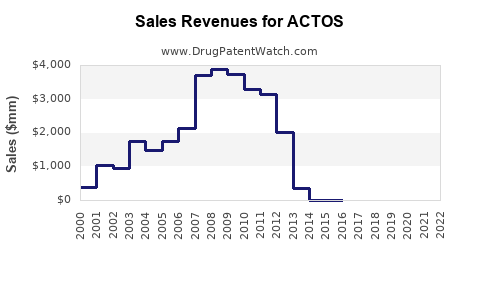
Year Global Sales (USD millions) Market Share (%) Key Events
2000 1,200 12 Market entry in US, approval expansion
2005 1,500 10.5 Increased adoption, patent status
2010 1,800 7.5 Rising competition, safety alerts
2015 1,200 6 Regulatory warnings, declining share
2020 700 2.4 Market erosion, generics entry

Revenue Trends and Market Share

  • Peak sales occurred around 2010, buoyed by wider acceptance and higher prescribing rates.
  • Decline post-2010 driven largely by safety concerns and newer classes such as SGLT2 inhibitors and GLP-1 RAs.
  • Sales decline accelerated post-2015 due to increased regulatory scrutiny and patent cliffs.

Regulatory and Safety Impact on Market Dynamics

FDA and EMA Actions

  • 2011: FDA issued warnings over bladder cancer risks; issued a REMS (Risk Evaluation and Mitigation Strategy).
  • 2018: EMA restricted use in certain populations.

Impact on Prescribing

  • Increased caution among physicians, favoring alternative therapies.
  • Class-specific stigma affecting both pioglitazone and similar agents.

Legal Litigation and Market Confidence

  • Lawsuits alleging links to bladder cancer spiked post-2011.
  • No significant financial penalty or recall, but reputational impact persisted.

Current Market Position and Key Stakeholders

Market Share and Revenue (2023)

Region Market Share (%) Estimated Revenue (USD millions) Key Competitors
United States 1.2 8 Actos, Meglitinides, SGLT2 inhibitors
Europe 1.0 6 Similar to US, with regional variants
Asia-Pacific 3.5 10 Cost-effective generics, local players
Latin America 2.8 4 Generic brands, cost-sensitive markets

Strategic Focus

  • Brand vs. generic: Original brand acting as a premium, while generics dominate volumes.
  • Regulatory compliance: Risks management and post-marketing surveillance remain vital.

Future Outlook and Market Evolution

Potential Resurgence Factors

  • Line Extensions: Combination therapies (e.g., ACTOS Plus) considered.
  • New Indications: Ongoing trials for non-diabetic indications such as NASH.
  • Market Expansion: Focus on emerging markets due to affordability advantages.

Challenges Reshaping Trajectory

  • Safety and Regulatory Scrutiny: Ongoing risk mitigation.
  • Competitive Innovation: SGLT2 inhibitors and GLP-1 RAs outperform due to superior safety profiles.
  • Patent Expirations & Generics: Reduced prices; erosion of margins.

Forecast: Revenue and Market Trends (2023–2030)

Year Estimated Global Sales (USD millions) Growth Rate (%) Main Drivers
2023 5 -35 Market niche, existing prescriptions
2025 4 -20 Competition, safety concerns
2030 2 -50 Generic saturation, new therapies

Comparison of Industry Trends and Key Competitive Therapeutics

Attribute ACTOS (Pioglitazone) SGLT2 Inhibitors (e.g., Empagliflozin) GLP-1 RAs (e.g., Semaglutide)
Mechanism PPARγ agonist Sodium-glucose co-transporter 2 inhibitors Glucagon-like peptide-1 receptor agonists
Efficacy (A1c reduction) ~0.5–1.0% ~0.7–1.5% ~1.0–1.8%
Safety profile Bladder cancer, edema Genitourinary infections, ketoacidosis Gastrointestinal side effects, rare pancreatitis
Cost (per course) Moderate High Very high
Regulatory outlook Restricted use Favorable, expanding indications Expanding, with novel formulations

FAQs

1. Why did ACTOS market share decline post-2010?
Safety concerns, particularly regarding bladder cancer risks, led to regulatory warnings and changed prescribing patterns, favoring alternative therapies with better safety profiles.

2. Are there ongoing efforts to expand ACTOS’s indications?
Yes. Clinical trials investigating pioglitazone for NASH and other metabolic disorders are underway, potentially opening new markets if approved.

3. How significant is the impact of generics on ACTOS revenues?
Patent expirations and the entry of generics have dramatically reduced prices and margins, contributing to the revenue decline observed after 2010.

4. Can ACTOS regain market share in the future?
Unlikely in the short term due to entrenched safety concerns and stiff competition but may find niche markets in cost-sensitive regions or new indication approvals.

5. What strategies could pharmaceutical companies use to sustain or improve ACTOS’s market positioning?
Investing in safety research, developing combination formulations, expanding indications, and targeted marketing in emerging markets can help prolong product viability.


Key Takeaways

  • ACTOS’s market success peaked around 2010 but has since declined owing to safety concerns, regulatory actions, and competitive innovations.
  • The drug retains a niche market primarily driven by its cost-effectiveness in emerging markets and potential investigational uses.
  • Regulatory restrictions and public perception significantly influence prescriber behavior, constraining growth.
  • The future trajectory depends on safety management, patent status, and clinical development efforts exploring new indications.
  • Overall, ACTOS exemplifies how safety profiles, regulatory frameworks, and competitive dynamics shape the lifecycle of blockbuster drugs in the evolving diabetes landscape.

References

[1] International Diabetes Federation. (2021). IDF Diabetes Atlas, 9th Edition.
[2] U.S. Food and Drug Administration. (2011). FDA Drug Safety Communication: Safety Review of Pioglitazone HCl and Evidence of Increased Risk of Bladder Cancer.
[3] European Medicines Agency. (2018). Summary of Opinion (SMO) for ACTOS restriction measures.
[4] MarketResearch.com. (2023). Global Diabetes Therapeutics Market Report.
[5] IQVIA. (2023). Prescription Trends in Diabetes Care.


This analysis aims to equip industry stakeholders, investors, and healthcare decision-makers with the critical insights necessary for strategic planning surrounding ACTOS.

More… ↓

⤷  Get Started Free

Make Better Decisions: Try a trial or see plans & pricing

Drugs may be covered by multiple patents or regulatory protections. All trademarks and applicant names are the property of their respective owners or licensors. Although great care is taken in the proper and correct provision of this service, thinkBiotech LLC does not accept any responsibility for possible consequences of errors or omissions in the provided data. The data presented herein is for information purposes only. There is no warranty that the data contained herein is error free. We do not provide individual investment advice. This service is not registered with any financial regulatory agency. The information we publish is educational only and based on our opinions plus our models. By using DrugPatentWatch you acknowledge that we do not provide personalized recommendations or advice. thinkBiotech performs no independent verification of facts as provided by public sources nor are attempts made to provide legal or investing advice. Any reliance on data provided herein is done solely at the discretion of the user. Users of this service are advised to seek professional advice and independent confirmation before considering acting on any of the provided information. thinkBiotech LLC reserves the right to amend, extend or withdraw any part or all of the offered service without notice.