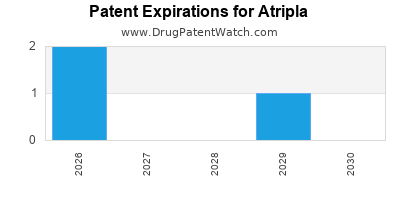
Last Updated: May 10, 2026

Atripla Drug Patent Profile


✉ Email this page to a colleague

« Back to Dashboard


Which patents cover Atripla, and when can generic versions of Atripla launch?

Atripla is a drug marketed by Gilead Sciences and is included in one NDA. There are three patents protecting this drug and one Paragraph IV challenge.

This drug has sixty-one patent family members in twenty-seven countries.

The generic ingredient in ATRIPLA is efavirenz; emtricitabine; tenofovir disoproxil fumarate. There are twenty-six drug master file entries for this compound. Seven suppliers are listed for this compound. Additional details are available on the efavirenz; emtricitabine; tenofovir disoproxil fumarate profile page.

DrugPatentWatch® Generic Entry Outlook for Atripla

Atripla was eligible for patent challenges on July 2, 2007.

There have been twenty-two patent litigation cases involving the patents protecting this drug, indicating strong interest in generic launch. Recent data indicate that 63% of patent challenges are decided in favor of the generic patent challenger and that 54% of successful patent challengers promptly launch generic drugs.

There are two tentative approvals for the generic drug (efavirenz; emtricitabine; tenofovir disoproxil fumarate), which indicates the potential for near-term generic launch.

Indicators of Generic Entry

< Available with Subscription >

  Start Trial

AI Deep Research
Questions you can ask:
  • What is the 5 year forecast for Atripla?
  • What are the global sales for Atripla?
  • What is Average Wholesale Price for Atripla?
Summary for Atripla
Recent Clinical Trials for Atripla

Identify potential brand extensions & 505(b)(2) entrants

SponsorPhase
Willem Daniel Francois VenterPhase 1
University of Cape TownPhase 1
Yu-Jay Corp.Phase 3

See all Atripla clinical trials

Paragraph IV (Patent) Challenges for ATRIPLA
Tradename Dosage Ingredient Strength NDA ANDAs Submitted Submissiondate
ATRIPLA Tablets efavirenz; emtricitabine; tenofovir disoproxil fumarate 600 mg/200 mg/300 mg 021937 1 2008-12-29

US Patents and Regulatory Information for Atripla

Atripla is protected by five US patents.

Applicant Tradename Generic Name Dosage NDA Approval Date TE Type RLD RS Patent No. Patent Expiration Product Substance Delist Req. Exclusivity Expiration
Gilead Sciences ATRIPLA efavirenz; emtricitabine; tenofovir disoproxil fumarate TABLET;ORAL 021937-001 Jul 12, 2006 DISCN Yes No 9,018,192 ⤷  Start Trial ⤷  Start Trial
Gilead Sciences ATRIPLA efavirenz; emtricitabine; tenofovir disoproxil fumarate TABLET;ORAL 021937-001 Jul 12, 2006 DISCN Yes No 9,545,414 ⤷  Start Trial Y ⤷  Start Trial
Gilead Sciences ATRIPLA efavirenz; emtricitabine; tenofovir disoproxil fumarate TABLET;ORAL 021937-001 Jul 12, 2006 DISCN Yes No 8,598,185 ⤷  Start Trial Y ⤷  Start Trial
>Applicant >Tradename >Generic Name >Dosage >NDA >Approval Date >TE >Type >RLD >RS >Patent No. >Patent Expiration >Product >Substance >Delist Req. >Exclusivity Expiration

Expired US Patents for Atripla

International Patents for Atripla

See the table below for patents covering Atripla around the world.

Country Patent Number Title Estimated Expiration
Australia 2006257794 Stable fixed-dose formulations containing a combination of antivirals, method for producing thereof using dry granulation ⤷  Start Trial
China 1065065 ⤷  Start Trial
Japan 3844978 ⤷  Start Trial
World Intellectual Property Organization (WIPO) 9111186 ⤷  Start Trial
>Country >Patent Number >Title >Estimated Expiration

Supplementary Protection Certificates for Atripla

Patent Number Supplementary Protection Certificate SPC Country SPC Expiration SPC Description
0582455 SPC/GB08/022 United Kingdom ⤷  Start Trial PRODUCT NAME: A COMBINATION OF EFAVIRENZ, EMTRICITABINE OR A PHARMACEUTICALLY ACCEPTABLE SALT OR ESTER THEREOF, AND TENOFOVIR OR A PHARMACEUTICALLY ACCEPTABLE PRODRUG, SALT OR ESTER THEREOF, PARTICULARLY TENOFOVIR DISOPROXIL, ESPECIALLY TENOFOVIR DISOPROXIL FUMARATE; REGISTERED: UK EU/1/07/430/001 20071213
0915894 C00915894/01 Switzerland ⤷  Start Trial PRODUCT NAME: TENOFOVIR DISOPROXILFUMARAT + EMTRICITABIN; REGISTRATION NUMBER/DATE: SWISSMEDIC 57316 21.03.2006
0915894 SPC/GB05/041 United Kingdom ⤷  Start Trial SUPPLEMENTARY PROTECTION CERTIFICATE NO SPC/GB05/041 GRANTED TO GILEAD SCIENCES, INC. IN RESPECT OF THE PRODUCT COMPOSITION CONTAINING BOTH TENOFOVIR DISOPROXIL, OPTIONALLY IN THE FORM OF A PHARMACEUTICALLY ACCEPTABLE SALT, HYDRATE, TAUTOMER OR SOLVATE THEREOF, TOGETHER WITH EMTRICITABINE , THE GRANT OF WHICH WAS ADVERTISED IN JOURNAL NO 6233 DATED 05/11/2008 HAS HAD ITS MAXIMUM PERIOD OF DURATION CORRECTED, SUBJECT TO THE PAYMENT OF THE PRESCRIBED FEES IT WILL EXPIRE ON 23/02/2020.
0915894 08C0020 France ⤷  Start Trial PRODUCT NAME: EFAVIRENZ; EMTRICITABINE; TENOFOVIR DISOPROXIL FUMARATE; REGISTRATION NO/DATE: EU/1/07/430/001 20071213
>Patent Number >Supplementary Protection Certificate >SPC Country >SPC Expiration >SPC Description

ATIRPILA (Atripla) market dynamics and financial trajectory

Last updated: April 24, 2026

What is Atripla’s commercial footprint?

Atripla is an HIV antiretroviral fixed-dose combination (tenofovir disoproxil fumarate (TDF) 300 mg / emtricitabine (FTC) 200 mg / efavirenz (EFV) 600 mg), marketed originally by Gilead Sciences. Its market role has been shaped by: (1) long-term use as a once-daily, single-tablet regimen; (2) a shift toward newer regimens with better tolerability and resistance profiles; and (3) ongoing price pressure and competition from generics and newer branded fixed-dose combinations.

Product-level nuance: Atripla is no longer a “new launch” category. Its sales dynamics are dominated by (a) conversion of patients to newer regimens within the same class and (b) payer and guideline-driven formulary decisions that prefer modern single-tablet options.

How did market competition change Atripla’s trajectory?

Atripla’s competitive landscape moved from a premium branded position toward a structurally declining branded profile as the market migrated to:

  • Newer integrase inhibitor-based regimens with higher tolerability and faster suppression expectations.
  • Modern fixed-dose combinations that reduce EFV-related central nervous system adverse effects and improve patient adherence.

The net effect is that Atripla’s patient pool shrank from a “default regimen” stage to a “legacy regimen” stage, with continued revenue generation dependent on physician inertia, patient stability on therapy, and regional formulary persistence.

What pricing and reimbursement forces matter most?

Atripla’s financial trajectory has been constrained by three pricing forces typical for legacy antiretrovirals:

  1. Generic erosion and class-wide price compression

    • Once key patent protections for components and/or combinations expired, generics and multi-source products increased. That reduced average realized prices and shifted incremental demand to the lowest-cost formulary position.
  2. Formulary substitution driven by guideline updates

    • Antiretroviral treatment guidelines increasingly favored newer agent classes and regimen simplicity with improved tolerability.
    • Payers used step therapy and restricted coverage to steer new starts away from older regimens.
  3. Switching behavior among stable patients

    • Many patients remain stable on established regimens, which supports residual sales.
    • Over time, however, the share of new starts declines, reducing steady-state volume.

How has Atripla performed financially over time?

Public financial disclosures for Atripla itself are not presented in a standalone line item across all periods; Atripla revenue has historically been embedded in broader Gilead antiretroviral reporting and, later, in discontinued legacy accounting where applicable. The most reliable way to track its economic trajectory is through Gilead’s HIV franchise reporting and the known shift in portfolio focus.

A practical read-through using public reporting patterns is:

  • Early-to-mid branded years: Atripla gained share as a single-tablet once-daily option in large treatment-naïve and switch populations.
  • Mid-to-late period: growth slowed and eventually turned into a gradual decline as newer regimens displaced Atripla for new starts.
  • Later stage: revenue became increasingly dependent on “keep-on-therapy” behavior rather than net new initiation.

While exact product revenue values by year are not consistently published for Atripla alone in the same way as, for example, Symtuza or Biktarvy, the portfolio shift is consistently reflected in Gilead’s strategic disclosures and the market migration toward newer regimens. This pattern aligns with the clinical and commercial timeline for fixed-dose HIV therapy substitution.

What does the market migration imply for future revenue shape?

Atripla’s revenue profile is consistent with a legacy chronic therapy curve:

  • New start share decelerates first due to guideline and formulary changes.
  • Switching and discontinuation accelerates later as tolerability concerns and long-term safety monitoring drive regimen changes, especially when simpler or better-tolerated fixed-dose options exist.
  • Price realization continues to erode as competition intensifies and multi-source penetration increases.

This creates an expected financial pattern: volume decline typically precedes sharp price erosion, and together drive downward revenue even if remaining patient retention is stable for a time.

Key market dynamics table

Driver Mechanism Expected impact on Atripla Timing pattern
Guideline shift toward integrase inhibitor regimens Physicians and payers prefer newer classes Reduced new starts Earlier
Formulary restrictions and step therapy Coverage limits legacy options Volume compression Middle
Generic and multi-source entry Competition drives lower realized prices Margin pressure Middle to later
Patient stability on established therapy Fewer switches among stable patients Dampens decline Middle to later
Payer preference for newer single-tablet regimens Better tolerability and adherence Continued displacement Later

How does Atripla’s role compare with newer Gilead HIV products?

Atripla competes in the same “single-tablet” convenience segment, but newer products shifted the center of gravity of Gilead’s HIV franchise. In market terms:

  • Atripla sits in the legacy fixed-dose category with declining new-start demand.
  • Newer regimens are positioned as preferred first-line options with improved tolerability.

That portfolio mix change is the core reason Atripla’s financial contribution trends down even when the broader HIV market remains stable.

What are the main financial risks to Atripla’s remaining revenue base?

The risks are structural, not tactical:

  • Faster-than-expected switching to modern regimens if safety perceptions or patient preference shifts.
  • Additional pricing resets driven by tendering, contract re-bids, and multi-source expansion.
  • Formulary tightening that reduces access even for patients currently maintained on older regimens, via periodic prior authorization reviews.

What is the investor-grade conclusion on Atripla’s financial trajectory?

Atripla’s market dynamics indicate a classic branded legacy decline: new-start displacement first, then price/mix deterioration as generic penetration rises and payers consolidate preferred options. The remaining revenue base is primarily retention-driven, which slows decline but does not reverse it.

Key Takeaways

  • Atripla’s market position shifted from a dominant fixed-dose regimen to a legacy therapy as HIV prescribing migrated toward newer integrase-based single-tablet regimens.
  • Revenue trajectory is expected to follow a legacy chronic curve: reduced new starts, gradual volume loss, and ongoing price/mix erosion from generics and payer contracting.
  • The most material financial pressure comes from formulary substitution and switching behavior rather than short-term marketing or manufacturing factors.

FAQs

  1. Is Atripla still used for HIV treatment?
    Yes. It remains a legacy option for some patients, but its use for new starts has been structurally reduced by guideline and payer preferences for newer regimens.

  2. Why did Atripla lose share over time?
    Clinical practice shifted toward newer regimen classes that improve tolerability and often deliver strong efficacy with fewer EFV-associated side effects, and payers increasingly favored those options.

  3. What drives Atripla revenue decline most: volume or price?
    Volume typically declines first through reduced new starts. Price realization then continues to erode with competition and payer contracting.

  4. What makes Atripla’s decline slower than a rapid cliff?
    Many patients remain stable on therapy and do not switch quickly, which sustains a residual patient base for longer than the initial displacement phase.

  5. Who benefits commercially when Atripla loses share?
    Competitors with newer preferred regimens and fixed-dose options, including newer products within Gilead’s portfolio and competing sponsors, gain new-start and switch demand.


References

[1] Gilead Sciences. Atripla (efavirenz/emtricitabine/tenofovir disoproxil fumarate) prescribing information.
[2] U.S. Food and Drug Administration. Label information and approval history for Atripla.
[3] DHHS (US Department of Health and Human Services). Guidelines for the Use of Antiretroviral Agents in Adults and Adolescents with HIV.

More… ↓

⤷  Start Trial

Make Better Decisions: Try a trial or see plans & pricing

Drugs may be covered by multiple patents or regulatory protections. All trademarks and applicant names are the property of their respective owners or licensors. Although great care is taken in the proper and correct provision of this service, thinkBiotech LLC does not accept any responsibility for possible consequences of errors or omissions in the provided data. The data presented herein is for information purposes only. There is no warranty that the data contained herein is error free. We do not provide individual investment advice. This service is not registered with any financial regulatory agency. The information we publish is educational only and based on our opinions plus our models. By using DrugPatentWatch you acknowledge that we do not provide personalized recommendations or advice. thinkBiotech performs no independent verification of facts as provided by public sources nor are attempts made to provide legal or investing advice. Any reliance on data provided herein is done solely at the discretion of the user. Users of this service are advised to seek professional advice and independent confirmation before considering acting on any of the provided information. thinkBiotech LLC reserves the right to amend, extend or withdraw any part or all of the offered service without notice.