Last updated: August 17, 2026
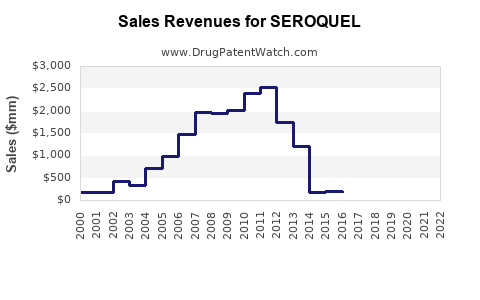
Seroquel, the branded quetiapine franchise developed by AstraZeneca, moved from blockbuster antipsychotic to mature generic product after U.S. exclusivity expired for immediate-release tablets in 2012 and extended-release tablets in the late 2010s. AstraZeneca generated roughly $4 billion to $5 billion in annual global Seroquel sales at peak, but revenue declined sharply after Paragraph IV litigation, generic entry, price erosion, and payer substitution. The product remains clinically important, but its commercial value is concentrated in generic quetiapine rather than branded revenue.
What is Seroquel and how does it work?
Seroquel is the brand name for quetiapine fumarate, an atypical antipsychotic marketed in immediate-release and extended-release formulations.
| Product |
Active ingredient |
Primary release profile |
Main FDA-approved uses |
| Seroquel |
Quetiapine fumarate |
Immediate release |
Schizophrenia; acute manic episodes associated with bipolar disorder; bipolar depression |
| Seroquel XR |
Quetiapine fumarate |
Extended release |
Schizophrenia; manic or mixed episodes in bipolar disorder; bipolar depression; adjunctive treatment of major depressive disorder |
Quetiapine acts primarily through antagonism of dopamine D2 and serotonin 5-HT2A receptors. Its pharmacology also produces histamine H1 and alpha-1 adrenergic receptor activity, which contributes to sedation, weight gain, and orthostatic hypotension.
The FDA approved Seroquel for schizophrenia in 1997. Subsequent approvals expanded the product into bipolar mania, bipolar depression, and adjunctive treatment for major depressive disorder. Seroquel XR broadened the commercial franchise by providing once-daily dosing and a formulation-specific patent position [1].
When did Seroquel lose exclusivity?
Seroquel lost effective U.S. market exclusivity in stages rather than on a single date.
| Milestone |
Approximate timing |
Commercial effect |
| FDA approval of immediate-release Seroquel |
1997 |
Established the original branded antipsychotic franchise |
| Core compound patent expiry |
December 2012 |
Enabled broad generic substitution for immediate-release quetiapine |
| Generic immediate-release entry |
2011-2012 |
Accelerated revenue decline before or around core patent expiry |
| Seroquel XR patent expiry period |
2016-2018 |
Opened the extended-release market to generic competition |
| Current market position |
Mature generic market |
Brand has limited pricing power and low strategic value relative to peak |
The principal compound patent commonly associated with Seroquel was U.S. Patent No. 4,879,288, which covered quetiapine-related subject matter and expired in the United States in December 2012, subject to applicable regulatory adjustments and pediatric exclusivity [2]. The extended-release product relied on separate formulation and method-related patent protection, including U.S. Patent No. 5,948,437, with protection extending into the late 2010s [3].
Exact entry dates varied by generic applicant, dosage strength, formulation, court outcome, and settlement terms. The commercial result was consistent: immediate-release price erosion occurred first, followed by extended-release erosion.
What patents protect Seroquel and Seroquel XR?
Seroquel’s patent estate consisted of several layers:
- Compound and pharmaceutical composition patents for quetiapine.
- Extended-release formulation patents for Seroquel XR.
- Method-of-use patents covering approved psychiatric indications.
- Regulatory exclusivity associated with new indications and pediatric studies.
- Manufacturing and formulation know-how that was difficult to reproduce commercially even after patent expiry.
The most commercially important protection was the compound patent for immediate-release Seroquel and the formulation patent estate for Seroquel XR. Method-of-use patents had lower blocking value because generic applicants could pursue labeling strategies that omitted protected indications, subject to the scope of the claims and applicable regulatory rules.
What formulations are protected by Seroquel patents?
The immediate-release product is comparatively exposed to conventional generic substitution because it does not depend on a complex delivery system. Seroquel XR had stronger formulation-based differentiation because its once-daily release profile required control of drug release, dissolution, tablet matrix behavior, and bioequivalence.
That protection delayed generic competition but did not create a durable barrier. Once generic extended-release manufacturers obtained FDA approval and satisfied patent or litigation requirements, the branded product faced the same structural pressures as other mature oral small-molecule drugs.
How did Paragraph IV challenges affect Seroquel?
Generic applicants challenged Seroquel patents through abbreviated new drug applications containing Paragraph IV certifications. These certifications asserted that listed patents were invalid, unenforceable, or would not be infringed by the proposed generic product.
AstraZeneca initiated patent litigation against multiple applicants seeking to market generic quetiapine, particularly for Seroquel XR. The disputes focused on whether proposed extended-release tablets fell within the asserted formulation claims and whether the patents were valid in light of prior art.
The litigation produced several commercial effects:
- It delayed some generic launches.
- It preserved part of the Seroquel XR revenue base during the late-life period.
- It shifted competition from the immediate-release product to the formulation-protected extended-release product.
- It created settlement and launch-date uncertainty for investors and generic competitors.
- It reduced the probability of a single, uniform generic-entry date across all strengths and formulations.
The ultimate loss of exclusivity was commercially more important than the outcome of any single case. After approval of generic alternatives, U.S. sales declined through substitution and aggressive contracting.
What is the FDA regulatory status of Seroquel?
Seroquel and Seroquel XR are FDA-approved prescription drugs. Quetiapine is an established active pharmaceutical ingredient with approved generic immediate-release and extended-release products.
| Regulatory issue |
Status |
| New drug application |
Approved |
| Active ingredient |
Quetiapine fumarate |
| Drug class |
Atypical antipsychotic |
| Generic pathway |
ANDA |
| Biosimilar pathway |
Not applicable |
| Orange Book relevance |
Applies to approved branded products and listed patents |
| Current regulatory risk |
Primarily labeling, manufacturing, pharmacovigilance, and product-quality risk |
Biosimilar competition is not relevant because Seroquel is a chemically synthesized small molecule, not a biologic. Generic manufacturers compete through ANDAs, bioequivalence, manufacturing capacity, distribution, and pharmacy substitution.
The main safety issues include metabolic changes, hyperglycemia, dyslipidemia, weight gain, somnolence, orthostatic hypotension, tardive dyskinesia, neuroleptic malignant syndrome, and increased mortality risk in elderly patients with dementia-related psychosis. These risks affect prescribing and monitoring but have not prevented quetiapine from becoming one of the most widely used atypical antipsychotics [1].
How many patents cover Seroquel today?
The original commercial patent estate no longer provides meaningful exclusivity for standard quetiapine products in the United States. Active patent listings may vary by jurisdiction, product presentation, and residual claim scope, but the key blocking patents for the original brand have expired.
| Patent category |
Historical role |
Current commercial effect |
| Quetiapine compound patent |
Protected the active pharmaceutical ingredient |
Expired |
| Immediate-release composition claims |
Supported branded Seroquel |
Expired or commercially non-blocking |
| Extended-release formulation claims |
Protected Seroquel XR |
Expired in the late 2010s |
| Method-of-use claims |
Covered psychiatric indications |
Limited blocking power after generic labeling strategies |
| Manufacturing know-how |
Supported quality and scale |
Can remain commercially useful but is not a product monopoly |
The estate is therefore weak as an exclusivity asset. It has historical litigation importance, but it does not support premium pricing for the original U.S. brand.
What was Seroquel’s peak revenue and how did sales decline?
Seroquel reached blockbuster status before generic erosion. AstraZeneca reported global Seroquel revenue of approximately $4 billion to $5 billion annually during the late 2000s and early 2010s, depending on reporting period and whether Seroquel XR was reported within the franchise [4,5].
A simplified trajectory is:
| Period |
Revenue direction |
Main driver |
| Late 1990s |
Rapid growth |
Initial schizophrenia adoption |
| Early 2000s |
Strong expansion |
Bipolar mania and broader atypical-antipsychotic use |
| 2006-2010 |
Peak commercial period |
Bipolar depression, Seroquel XR, and adjunctive depression use |
| 2011-2013 |
Sharp decline |
Immediate-release generic entry and price erosion |
| 2014-2017 |
Continued decline |
Loss of branded volume and pressure on XR |
| After 2017 |
Mature-product economics |
Generic substitution and limited branded demand |
The franchise’s decline was structural rather than cyclical. The major drivers were:
- Loss of compound-patent protection.
- Generic substitution at the pharmacy level.
- Lower reimbursement for branded quetiapine.
- Therapeutic competition from aripiprazole, risperidone, olanzapine, lurasidone, cariprazine, and other antipsychotics.
- Greater payer control over atypical antipsychotic formularies.
- Reduced ability to preserve price through formulation differentiation after XR generic entry.
The product remained widely prescribed because quetiapine has multiple approved indications, flexible dosing, immediate- and extended-release presentations, and substantial clinical familiarity. Volume persistence did not translate into branded revenue retention.
How does Seroquel compare with competing antipsychotics?
Seroquel’s market position differs by indication and formulation.
| Drug |
Generic status |
Key competitive position |
| Quetiapine |
Broadly generic |
High familiarity, multiple indications, strong historical use |
| Aripiprazole |
Generic |
Lower metabolic burden in some patients; strong maintenance and adjunctive depression use |
| Risperidone |
Generic |
Low-cost, broad use, long-acting injectable options |
| Olanzapine |
Generic |
Strong efficacy perception but substantial metabolic liability |
| Lurasidone |
Generic in the U.S. after later patent expiry |
Bipolar depression positioning and lower metabolic profile relative to some competitors |
| Cariprazine |
Branded during the relevant period |
Newer mechanism and bipolar depression/mania positioning |
| Brexpiprazole |
Branded during the relevant period |
Schizophrenia and adjunctive depression positioning |
Seroquel’s advantages are broad indication coverage and low generic cost. Its disadvantages include sedation, weight gain, metabolic effects, and competition from newer drugs with more targeted commercial positioning.
The commercial battle has therefore shifted from brand differentiation to formulary placement, generic supply reliability, clinical familiarity, and use in specific patient segments.
What licensing deals affected Seroquel?
AstraZeneca retained primary control of the Seroquel franchise. The product’s economics were driven more by internal development, regulatory expansion, generic litigation, and geographic commercialization than by a transformative licensing transaction.
Regional commercialization arrangements and generic supply relationships may have existed in individual markets, but they did not materially change the U.S. patent-loss trajectory. The principal value transfer occurred through generic competition after exclusivity expiry rather than through a major late-life licensing deal.
What patent litigation affects Seroquel?
The most consequential litigation involved AstraZeneca’s enforcement of Seroquel XR patents against ANDA applicants. The legal disputes centered on:
- Validity of extended-release formulation claims.
- Infringement by generic release-control systems.
- Non-infringement based on design differences.
- Paragraph IV certification strategy.
- Settlement terms and potential launch dates.
The litigation had a time-limited defensive function. It could postpone entry and preserve revenue, but it could not permanently protect a small-molecule product after the core patents expired.
What generic entry risks exist for Seroquel?
Current generic-entry risk is largely realized rather than prospective. The relevant risk has shifted from first generic launch to continuing price and volume erosion.
U.S. generic launch scenarios
For immediate-release quetiapine, the launch sequence produced rapid substitution across common strengths. For extended-release quetiapine, entry was more dependent on formulation approval and patent resolution.
The principal current risks are:
- Further branded-to-generic substitution.
- Consolidation among generic manufacturers.
- Temporary shortages caused by manufacturing or supply-chain disruption.
- Reimbursement compression.
- Loss of residual demand for Seroquel XR where generic extended-release products are available.
No new pediatric exclusivity or regulatory exclusivity period can restore the original Seroquel franchise. Any commercial opportunity would require a new formulation, new indication, or separate delivery technology.
What manufacturing and intellectual-property barriers remain?
Manufacturing barriers are modest for immediate-release tablets and higher for extended-release tablets. Extended-release production requires validated dissolution performance, consistent excipient behavior, process controls, and bioequivalence across the relevant strengths.
These requirements can delay approval or create quality problems, but they do not create durable exclusivity after patent expiry. The remaining commercial barriers include:
- FDA-compliant manufacturing capacity.
- Reliable supply of quetiapine fumarate.
- Bioequivalence across dosage strengths.
- Controlled-release process validation.
- Pharmacovigilance and labeling compliance.
- Distribution access and payer contracts.
The strongest residual know-how is operational rather than patent-based.
How strong is the Seroquel patent estate?
Seroquel’s historical patent estate was strong enough to support blockbuster economics, but its current strength is low.
| Dimension |
Assessment |
| Historical compound protection |
Strong |
| Extended-release protection |
Moderate to strong before expiry |
| Current U.S. blocking power |
Low |
| Method-of-use protection |
Limited |
| Manufacturing know-how |
Moderate operational value |
| Biosimilar barrier |
Not applicable |
| Litigation leverage today |
Low |
| Revenue protection potential |
Minimal |
For investors and licensing teams, Seroquel should be analyzed as a mature generic market, not as an active branded patent platform.
What is the commercial outlook for Seroquel?
Seroquel’s future revenue profile is stable at the molecule level but weak at the brand level. Quetiapine should remain widely used because of its established clinical role, multiple approved indications, extensive physician familiarity, and low generic cost.
AstraZeneca’s direct branded economics are limited by:
- Expired U.S. patents.
- Generic availability in major markets.
- Low switching costs for payers.
- Broad therapeutic competition.
- Lack of a durable formulation moat.
The principal value lies in generic quetiapine volume, regional branded remnants, authorized-generic arrangements where applicable, and potential reformulation strategies. A new commercial platform would need to provide a meaningful adherence, tolerability, pharmacokinetic, or indication advantage.
Key Takeaways
- Seroquel is quetiapine fumarate, an atypical antipsychotic approved for schizophrenia, bipolar disorder, and adjunctive major depressive disorder.
- AstraZeneca’s Seroquel franchise reached approximately $4 billion to $5 billion in annual global sales at peak.
- Immediate-release exclusivity ended around 2012; extended-release protection ended in the late 2010s.
- Paragraph IV litigation delayed parts of generic Seroquel XR entry but did not prevent long-term erosion.
- Seroquel is a small molecule, so biosimilar risk does not apply.
- The current U.S. market is primarily generic and price-sensitive.
- The historical patent estate was commercially valuable; its present blocking power is low.
- Future value depends on generic volume, supply reliability, and any differentiated reformulation rather than the original brand.
FAQs
Is Seroquel still under patent protection?
The core U.S. patents protecting immediate-release and extended-release quetiapine have expired. Residual claims or jurisdiction-specific listings may exist, but they do not recreate the original Seroquel monopoly.
Did AstraZeneca settle with generic manufacturers over Seroquel?
AstraZeneca litigated against multiple ANDA applicants, and generic entry timing varied by applicant and formulation. Settlement and litigation outcomes affected launch timing, particularly for Seroquel XR.
Is generic quetiapine therapeutically equivalent to Seroquel?
FDA-approved generic quetiapine products must satisfy applicable bioequivalence and quality requirements. Substitution depends on the specific product, dosage form, state law, payer policy, and prescriber instructions.
Why did Seroquel sales fall faster than prescription volume?
Generic substitution sharply reduced the price per prescription. Prescription demand could remain substantial while branded revenue declined because payers and pharmacies moved patients to lower-cost generic quetiapine.
Can a new Seroquel formulation regain exclusivity?
A new formulation could receive patent protection or regulatory exclusivity if it meets statutory requirements. Commercial success would depend on demonstrating a clinically meaningful advantage over inexpensive immediate-release and extended-release generic quetiapine.
References
-
U.S. Food and Drug Administration. (2023). Seroquel prescribing information. AstraZeneca Pharmaceuticals LP.
-
U.S. Patent and Trademark Office. (1989). U.S. Patent No. 4,879,288: Dibenzothiazepine derivatives. U.S. Department of Commerce.
-
U.S. Patent and Trademark Office. (1999). U.S. Patent No. 5,948,437: Sustained release formulation of quetiapine. U.S. Department of Commerce.
-
AstraZeneca PLC. (2011). Annual report and Form 20-F 2010. AstraZeneca.
-
AstraZeneca PLC. (2014). Annual report and Form 20-F 2013. AstraZeneca.