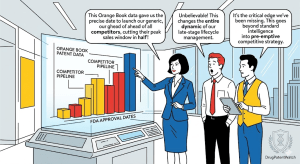
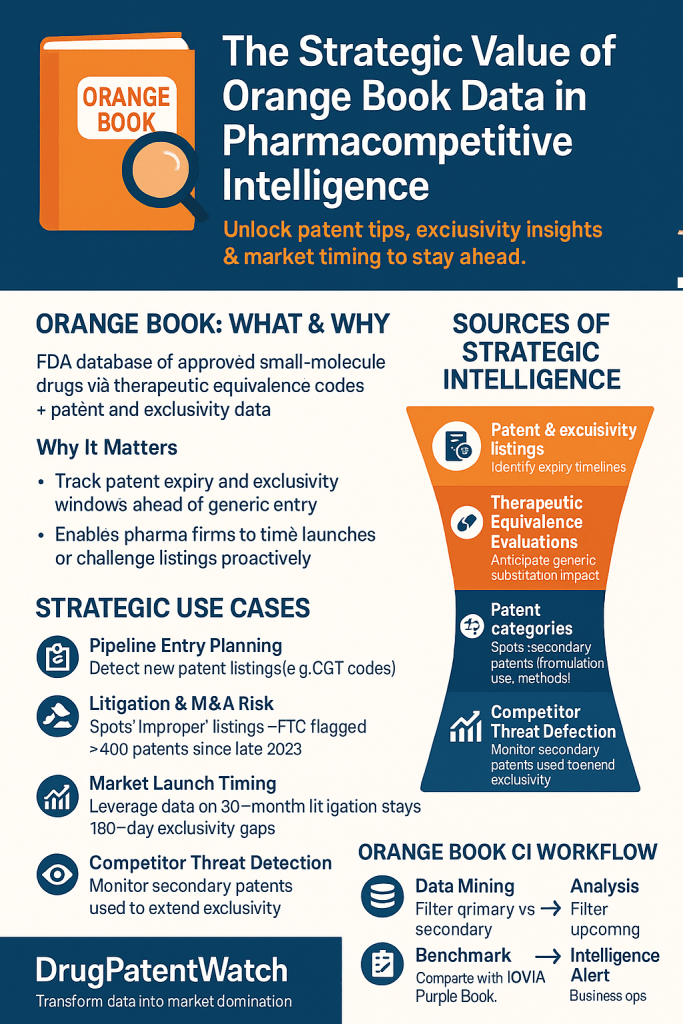
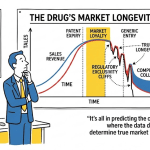
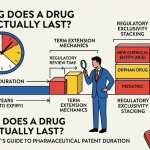
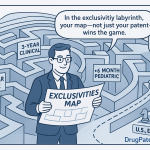
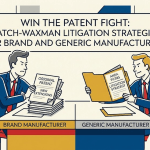
The FDA’s Orange Book is not a passive regulatory registry. It is the legal terrain on which more than $200 billion in annual U.S. generic drug revenue is contested. Every Paragraph IV filing, every 30-month automatic stay, every authorized generic decision, and every “skinny label” carve-out flows from data that was first lodged in its pages. Analysts who treat it as a lookup tool rather than a strategic intelligence system are leaving serious money on the table.
Orange Book patent listings are the single most powerful tool a brand manufacturer has to delay generic entry under the Hatch-Waxman Act, because listing a patent forces any ANDA applicant to certify against it or wait.
The distinction between Drug Substance (DS), Drug Product (DP), and method-of-use (U-68) patent flags determines how costly and time-consuming a generic challenge will be, directly affecting the risk-adjusted NPV of any ANDA program.
Regulatory exclusivities, particularly new chemical entity (NCE) and pediatric exclusivity extensions, are economically distinct from patent protection. They cannot be challenged via Paragraph IV, making them the “hard floor” of any brand’s exclusivity model.
The 180-day first-filer exclusivity available to the first generic applicant filing a Paragraph IV certification is one of the most valuable regulatory assets in the pharmaceutical industry, often worth hundreds of millions of dollars in a single product cycle.
The FTC’s 2023-2025 campaign against improper Orange Book listings, particularly device-drug combination patents, has introduced material delisting risk to brand IP portfolios that previously faced no administrative review mechanism.
Orange Book data is structurally incomplete for biologics, combination products with a primary biologic mode of action, and any drug approved outside the NDA pathway. Analysts must supplement it with Purple Book data, FDA BLA databases, and PTAB proceedings for full coverage.
Machine learning applications for Orange Book analysis are maturing rapidly, with predictive models for Paragraph IV challenge outcomes, generic entry timing, and patent term extension (PTE) success rates now commercially available from multiple vendors.
Section 1: What the Orange Book Actually Is, and What It Is Not
The Regulatory Foundation
The Orange Book, formally titled “Approved Drug Products with Therapeutic Equivalence Evaluations,” is a compilation the FDA has published annually since October 1980. Its primary function at inception was clinical: give pharmacists and prescribers a reference for which generic products the FDA considered therapeutically equivalent to brand-name drugs, enabling pharmacy-level substitution. Congress dramatically enlarged its competitive significance with the Drug Price Competition and Patent Term Restoration Act of 1984, the statute universally called Hatch-Waxman.
After 1984, any NDA holder whose drug was listed in the Orange Book had to submit patent information covering the drug substance, drug product, and approved methods of use within 30 days of NDA approval or patent issuance, whichever came later. That obligation turned the Orange Book from a clinical reference into the primary public registry of pharmaceutical IP protection in the U.S. market. Every ANDA applicant must then certify against every listed patent, and a Paragraph IV certification triggers the brand’s option to sue and obtain an automatic 30-month stay on FDA approval. The Orange Book is, in practical terms, the mechanism through which the Hatch-Waxman Act’s litigation architecture operates.
That litigation architecture is not a bug. It was the deliberate legislative deal: brand manufacturers got a public forum in which to assert IP rights and a built-in litigation hold, while generic manufacturers got a streamlined approval pathway that relied on the brand’s clinical data rather than requiring independent Phase I-III trials. Both sides got a known playing field. The Orange Book is the rulebook.
The Ministerial Role of the FDA and Its Consequences
The FDA does not verify whether a submitted patent actually claims the approved drug product or method of use. The agency accepts submissions and lists them, a function it has consistently described as “ministerial.” This creates a structurally significant asymmetry: patent holders self-certify listability, and the burden to challenge the propriety of a listing falls on generic competitors through expensive Paragraph IV litigation. The practical result, documented in the NBER’s Orange Book Dataset covering 1985-2016, is that the Orange Book contains patents that could not survive a legal challenge to their listability, alongside patents that constitute entirely legitimate IP protection.
The FTC identified this asymmetry as an anticompetitive mechanism beginning with its 2002 report “Generic Drug Entry Prior to Patent Expiration” and returned to it forcefully in 2022 and 2023 by challenging more than 100 patents as improperly listed. Those challenges, concentrated in device-drug combination products including AstraZeneca’s Symbicort inhaler patents, Mylan’s EpiPen auto-injector patents, and tezepelumab device patents, made clear that the ministerial listing standard was being stretched to cover patents on delivery mechanisms that do not directly claim the approved drug product.
For competitive intelligence purposes, the ministerial standard means two things. First, not every Orange Book patent is a genuine barrier. Some would fail a proper claim-scope analysis against the approved product. Second, the FTC’s intervention has now created a delisting pathway that did not meaningfully exist before 2022, introducing a new risk variable for brand manufacturers whose portfolio strategy relied on device patents listed in the Orange Book.
Key Takeaways: Orange Book Foundations
The Orange Book is the operational foundation of Hatch-Waxman litigation: no listing, no 30-month stay, no automatic litigation hold on generic approval.
FDA’s ministerial listing standard means Orange Book patent coverage is not self-evidently valid. Competitive intelligence teams must independently assess claim scope against the approved product label.
The FTC’s active delisting campaign (2022-2025) is a new risk factor for any brand IP portfolio relying on device-drug combination or peripheral patents to extend exclusivity.
The Orange Book covers NDA-approved small-molecule drugs and certain combination products. It does not cover BLA-approved biologics, and it does not cover manufacturing process patents, intermediates, or packaging patents, regardless of their commercial significance.
Section 2: The Hatch-Waxman Architecture That Built the Modern Generic Industry
Patent Certifications: Paragraphs I Through IV
Every ANDA applicant must certify to the FDA regarding each patent listed in the Orange Book for the reference listed drug (RLD). The certification framework has four options. A Paragraph I certification states that the Orange Book contains no patent for the drug. A Paragraph II certification states that the relevant patent has expired. A Paragraph III certification states that the applicant will not seek approval before the patent expires, effectively conceding the IP issue. A Paragraph IV certification asserts that the listed patent is invalid, unenforceable, or will not be infringed by the generic product.
Paragraph IV is the only path to pre-patent-expiration generic entry, and it is the only certification that triggers litigation rights for the NDA holder. Once the brand manufacturer receives notice of a Paragraph IV filing and files suit within 45 days, the FDA cannot grant final approval of the ANDA for 30 months, unless a court resolves the patent dispute before that window closes. The 30-month stay is automatic; courts need not issue an injunction. This is the mechanism that makes Orange Book patent listings so strategically valuable: a single listing converts a patent into a time-gated regulatory hold on competitors.
The NDA holder has 45 days to file suit after receiving the Paragraph IV notice. If it misses that window, the 30-month stay does not attach, and the FDA can approve the ANDA upon meeting all technical requirements. Brand manufacturers therefore maintain Orange Book monitoring infrastructure specifically to catch Paragraph IV notices and ensure no filing deadline is missed.
The 180-Day First-Filer Exclusivity: The Most Valuable Short-Term IP Asset in Generics
The first ANDA applicant to file a Paragraph IV certification against a given patent earns a 180-day period during which the FDA will not approve any other ANDA for the same drug. This exclusivity period is a regulatory asset, not a patent right. It cannot be challenged through PTAB inter partes review, it cannot be invalidated by a court, and it does not depend on winning the underlying patent litigation. The 180-day exclusivity attaches to the ANDA, not the patent, and is triggered by the first commercial marketing of the generic product or a court decision that the patent is invalid or not infringed, whichever comes first.
The commercial value of 180-day exclusivity scales directly with the size of the brand market. For a drug generating $2 billion annually, a generic capturing 70% of volume at 80% of brand price during a 180-day exclusive window represents roughly $560 million in gross revenue before manufacturing costs. For ANDA programs on blockbuster drugs, the filing date of the first Paragraph IV certification is therefore a financially material event tracked in real time by every serious competitive intelligence function in the generics industry.
Multiple applicants can file Paragraph IV certifications on the same day, sharing the 180-day exclusivity as co-first-filers. This “shared exclusivity” scenario reduces individual economics but still substantially outperforms the post-180-day competitive market. Orange Book data, combined with ANDA approval action letters and settlement disclosures, allows analysts to reconstruct the first-filer roster for any given drug and model the shared versus exclusive revenue scenarios.
INVESTMENT NOTE: For institutional investors in generic pharma companies, the presence of a Paragraph IV first-filer position in an undisclosed ANDA is the single highest-leverage undisclosed asset on a company’s IP roster. Teva’s $1.8 billion Protonix settlement in 2013 and Ranbaxy’s forfeiture of 180-day exclusivity on multiple products illustrate just how consequential these positions can be.
Patent Term Extension Under Hatch-Waxman
The same statute that created the ANDA pathway also established Patent Term Extension (PTE), which compensates patent holders for regulatory review time lost during the FDA approval process. An NDA holder may restore up to five years of patent term, subject to a cap of 14 years of effective patent life post-approval, for one patent per approved product. The calculation is based on time spent in IND clinical trials (half-time credit) plus full-time credit for the FDA’s NDA review period.
The NBER Orange Book Dataset demonstrates that PTE concentrates heavily on active ingredient patents. In its sample of drugs experiencing generic entry between 2001 and 2010, 79% of drug substance patents received PTE, compared with 13% of non-substance patents. This concentration is economically rational: the composition-of-matter patent on the active ingredient is typically the last, largest legal barrier to generic entry. Extending it by even 18 months on a $3 billion product is worth more than most entire ANDA development programs.
PTE applications are filed with the USPTO and publicly available. Monitoring PTE applications allows competitive intelligence teams to refine generic entry timelines beyond the stated patent expiration date. An analyst who models entry on the base patent term without checking for pending PTE applications will consistently produce early entry forecasts, sometimes by years.
Key Takeaways: Hatch-Waxman Mechanics
A Paragraph IV certification is both a legal assertion and a competitive action. The 45-day suit deadline means brand manufacturers must have Orange Book monitoring and legal response protocols in place at all times.
The 30-month stay is the most powerful tool the Orange Book listing mechanism provides to brand manufacturers. Each additional patent listed extends the potential litigation hold, though courts have occasionally invalidated stays when patents were improperly listed.
180-day first-filer exclusivity is a regulatory asset worth hundreds of millions of dollars on blockbuster drugs. The filing date of a Paragraph IV certification, even when confidential under ANDA docketing rules, eventually becomes discernible through court filings, settlement announcements, and Orange Book certification date stamps.
PTE applications require independent monitoring via the USPTO. Orange Book patent expiration dates without PTE adjustment can be materially inaccurate as generic entry forecasting inputs.
Investment Strategy: Hatch-Waxman Positioning
For analysts covering generic manufacturers, the primary Orange Book-driven valuation variable is the ANDA pipeline’s Paragraph IV exposure. A company with multiple undisclosed first-filer positions against drugs with $500 million-plus annual U.S. sales represents a materially undervalued pipeline if those positions are not yet reflected in Street estimates. Assess the company’s litigation settlement history: a pattern of settlements with authorized generic agreements signals a strategy of monetizing 180-day exclusivity without full commercial execution, which produces more predictable but lower-ceiling revenue.
For brand companies, the key question is how many months of exclusivity remain after stripping out patents likely to be invalidated or designed around and adjusting for realistic PTE outcomes. A brand carrying a $4 billion product with 12 listed patents deserves scrutiny on each patent’s claim scope, its litigation history, and its PTE status, because the effective exclusivity runway may be six years shorter than the nominal last-patent-expiration date suggests.
Section 3: Orange Book Data Taxonomy: A Technical Breakdown for Analysts
Therapeutic Equivalence Codes
Therapeutic equivalence (TE) codes determine whether a generic product can be automatically substituted for a brand at the pharmacy counter, which is the single most important factor in generic market penetration speed. A product rated AB is substitutable in all 50 states under generic substitution laws. A product without an AB rating, or one rated BX or B*, cannot be automatically substituted and must be specifically prescribed by name, dramatically reducing the generic’s market capture rate.
The TE code is determined based on scientific and regulatory criteria that the FDA applies at the time of ANDA approval. It is not static. A product initially rated BX can be reclassified to AB if the applicant provides additional bioequivalence data. Conversely, FDA can downgrade TE ratings if post-market data reveals unexpected performance issues. Monitoring TE code changes is a non-trivial intelligence function: an upgrade from BX to AB for a pending generic represents a step-change in its commercial prospects, while a downgrade for an existing generic can shift the competitive balance in a category overnight.
The table below maps TE codes to their competitive implications for formulary access and pharmacy substitution.
TE Code
Interpretation
Competitive Implication
AB
Bioequivalent; substitutable in all states
Direct generic substitution permitted at pharmacy
AP
Bioequivalent injectable or topical
Substitution possible; form-specific
AT
Bioequivalent topical
Substitution varies by state law
BX
Data insufficient to rate
No automatic substitution; requires physician consent
B*
Bioequivalence problems known or suspected
Significant formulary access risk for generic
Patent Flag Taxonomy: DS, DP, and Method-of-Use
Since 2004, the Orange Book has flagged patents with codes that identify the type of protection claimed. This flag taxonomy is directly relevant to litigation strategy because each patent type presents a different challenge difficulty and a different design-around pathway. A generic applicant does not challenge all Orange Book patents equally. It selects the challenge portfolio based on claim scope, prosecution history, and the feasibility of carving out the patented use on the product label.
Flag
Patent Category
Example Claim Scope
Typical Litigated?
DS
Drug Substance (active ingredient / polymorph)
Compound X in crystalline Form II
Yes, almost always first challenged
DP
Drug Product (formulation, excipient, delivery)
Extended-release matrix with HPMC at pH 6-7
Yes, but easier to design around
U-68
Method of Use
Method of treating hypertension in patients with CKD
Contested; skinny label carve-outs common
PC
Product Combination (device + drug)
Drug-device combo, e.g., autoinjector
FTC-challenged; active litigation 2023-2025
The method-of-use (U-68) patent category warrants extended analysis. When a brand holds method-of-use patents on specific indications, a generic applicant can file an ANDA with a “skinny label” that carves out the patented indication. Under 21 U.S.C. 505(j)(2)(A)(viii), the generic does not need approval for a patented indication, and its label can omit that indication without triggering a Paragraph IV certification on the method-of-use patent. The brand cannot sue for infringement of the method-of-use patent based solely on the generic’s FDA-approved label.
Skinny labeling has been the subject of intense litigation, culminating in the 2022 Federal Circuit decision in GlaxoSmithKline v. Teva Pharmaceuticals involving carvedilol. The court found that Teva’s marketing materials, which referenced carvedilol as a heart failure drug even though the skinny label omitted that indication, could support a finding of induced infringement of GSK’s method-of-use patent. The case settled, but it established that skinny labeling is not an absolute safe harbor if the generic’s commercial messaging references the patented method. Competitive intelligence teams tracking method-of-use patents now monitor generic companies’ launch materials, not just their labels.
Regulatory Exclusivity Codes and Their IP Valuation Implications
Regulatory exclusivities protect a drug from generic competition through a distinct legal mechanism from patents. They are granted by the FDA as statutory incentives for specific types of drug development, and they cannot be challenged via Paragraph IV or PTAB. For IP valuation purposes, they represent the “hard floor” of market exclusivity: even if every Orange Book-listed patent were invalidated or designed around tomorrow, a drug within its NCE exclusivity window cannot receive a final generic ANDA approval.
Code
Exclusivity Type
Duration
Trigger Statute
NCE
New Chemical Entity
5 years
21 U.S.C. 355(c)(3)(E)
NP
New Product (no NCE; new indication/formulation)
3 years
21 U.S.C. 355(c)(3)(E)
ODE
Orphan Drug Exclusivity
7 years
21 U.S.C. 360cc
PED
Pediatric Exclusivity (add-on, not standalone)
+6 months appended
21 U.S.C. 355a
NPP
New Pediatric Product
3 years
BPCA/PREA
D-180
180-Day Generic Exclusivity (first filer)
180 days post first commercial mktg
21 U.S.C. 355(j)(5)(B)(iv)
The pediatric exclusivity extension (PED) deserves special attention in IP valuation models. It is not a standalone exclusivity; it attaches as a six-month extension to any other form of market protection, including patents and other exclusivities, that would otherwise expire. On a $3 billion drug, a PED extension generating six additional months of exclusivity is worth roughly $1.5 billion in brand revenue net of cannibalization. Identifying which products have qualifying pediatric study requests (Written Requests) outstanding is therefore a material input to brand revenue forecasting.
Key Takeaways: Data Taxonomy
TE codes determine commercial penetration speed, not just regulatory status. BX-rated generics require physician-specific prescribing and will capture market share far more slowly than AB-rated equivalents, regardless of price competitiveness.
Patent flag categories (DS, DP, U-68, PC) are not interchangeable risk categories. Drug substance patents are typically the highest-value and highest-priority challenges; device-drug combination (PC) patents are now the highest-risk from a delisting standpoint.
Regulatory exclusivities are unchallengeable via ANDA litigation pathways. Any generic entry model that does not separately track exclusivity end-dates from patent expiry dates will produce systematically optimistic entry timeline forecasts.
Pediatric exclusivity extensions are easily overlooked in patent-expiry-focused analyses. Every brand IP model should flag outstanding pediatric Written Requests as a six-month revenue extension risk not visible in patent data alone.
Section 4: IP Valuation Through an Orange Book Lens
Why Orange Book Listings Are Core Balance Sheet Assets
In the pharmaceutical industry, an Orange Book listing is not incidental to a drug’s value. It is a primary determinant of that value. A composition-of-matter patent listed in the Orange Book converts an abstract IP right into a regulatory enforcement mechanism: the FDA will not approve competing products while the 30-month stay is active, and the generic applicant must clear every listed patent, either through litigation, licensing, or design-around, before gaining final approval. The Orange Book listing is what transforms a patent into a cash-flow-generating barrier, not merely an exclusion right.
This has direct implications for pharmaceutical M&A due diligence and portfolio valuation. When acquiring a drug or a company, the relevant questions are not just “when does the last patent expire?” but “how many patents are listed, what types are they, what is the litigation history on each, and what is the probability that each survives a Paragraph IV challenge?” Each of those answers adjusts the effective exclusivity duration and therefore the net present value of the revenue stream.
The Anatomy of a Drug’s IP Valuation: A Worked Framework
A rigorous Orange Book-based IP valuation of a single drug product requires five distinct analytical steps. First, enumerate all Orange Book-listed patents and classify each by flag (DS, DP, U-68, PC), PTE status, and remaining term. Second, for each patent, estimate the probability of surviving a Paragraph IV challenge based on prosecution history, prior art exposure, and any existing litigation outcomes. Third, identify all regulatory exclusivities and their end dates, recognizing these as the unchallengeable floor of the exclusivity runway. Fourth, model generic entry scenarios under weighted probability distributions, rather than single-point expiry dates, because the commercial impact of a 12-month variance in generic entry timing on a $2 billion product is approximately $1 billion in brand net revenue. Fifth, apply price erosion curves based on the expected number of generic entrants, since the first generic typically enters at 20-30% below brand price and subsequent entrants drive average prices to 10-15% of brand within 18-24 months of multi-source generic competition.
This framework yields a probability-weighted effective patent life (EPL), which is the single most useful IP valuation metric for a small-molecule drug. EPL differs from nominal last-patent-expiry by the discount applied to each listed patent based on its challenge vulnerability, plus or minus any PTE adjustments. For drugs with complex patent thickets, the EPL is often meaningfully shorter than nominal expiry. For drugs with clean DS patents and no outstanding Paragraph IV challenges, it may be close to nominal.
IP Valuation Case Study: A Blockbuster With a Multi-Layered Patent Estate
Consider a hypothetical immunology drug with $4.5 billion in annual U.S. net revenue. The Orange Book shows nine listed patents. The composition-of-matter patent expires in 2028, with PTE extending it to 2030. Four formulation patents expire between 2029 and 2033. Three method-of-use patents covering specific patient subpopulations expire between 2031 and 2034. A device patent on the autoinjector expires in 2035.
A naive analysis would cite 2035 as the “effective” exclusivity end date. An Orange Book-based IP valuation would note: the composition-of-matter patent is the primary commercial barrier and the most likely challenge target; the formulation patents are more defensible than composition patents on average, but two of the four have claim language that a competent ANDA challenger could design around using alternative excipients; the method-of-use patents are addressable via skinny labeling for most generic entrants; and the device patent is now subject to FTC delisting risk under the 2023-2025 campaign. A probability-weighted EPL analysis might assign a 65% probability of generic entry by 2031, a 25% probability of entry by 2033, and a 10% probability of full exclusivity through 2035. The revenue impact of that distribution, discounted to present value, would be substantially lower than the single-point 2035 analysis.
Key Takeaways: IP Valuation
Orange Book listings convert patents from exclusion rights into revenue-maintaining regulatory barriers. The listing mechanism, not the patent itself, is what blocks FDA approval.
A rigorous IP valuation model weights each listed patent by its Paragraph IV challenge probability, not just its expiry date. Listing count is a weak proxy for protection quality.
Effective patent life (EPL), probability-weighted across challenge scenarios, is more accurate than nominal last-patent-expiry as a forecasting input for revenue cliff modeling.
PTE adjustment is mandatory for any near-term exclusivity analysis. Unadjusted base patent terms systematically understate remaining exclusivity for products still within their PTE window.
Investment Strategy: IP Valuation for M&A and Asset Pricing
In pharmaceutical M&A, Orange Book analysis is a due diligence requirement, not a supplementary check. Any acquisition of a branded drug or a generic ANDA pipeline should include a full Orange Book audit: enumerate all listed patents, assess claim scope against the approved label and formulation, check PTE status, identify any outstanding Paragraph IV challenges or settlements, and review any regulatory exclusivities with their specific end-date calculations.
For buy-side analysts evaluating brand pharma companies, the most common valuation error is taking company-disclosed “loss-of-exclusivity” dates at face value. Companies typically disclose nominal last-patent-expiry without discounting for challenge probability. Building a bottom-up Orange Book model with independent claim scope assessments typically produces earlier effective exclusivity end dates, lower long-term revenue estimates, and meaningfully lower DCF-based price targets than consensus for brand companies with aging blockbuster franchises.
Section 5: Paragraph IV Mechanics: The Litigation Engine of the Generic Industry
The Paragraph IV Notice and Its Strategic Significance
The Paragraph IV certification process starts when an ANDA applicant files its application with the FDA and certifies that a listed patent is invalid, unenforceable, or will not be infringed by its generic product. The applicant must then send a notice letter to the NDA holder and patent owner within 20 days of ANDA filing. This notice is a formal legal document that must include a detailed statement explaining, on a claim-by-claim basis, why each challenged patent is invalid, unenforceable, or not infringed. The detailed statement is, in practice, the generic manufacturer’s litigation roadmap delivered to its adversary before any complaint is filed.
The NDA holder receives the notice and has 45 days to file patent infringement suit in federal district court. Most brand manufacturers with commercially significant products file suit reflexively on every Paragraph IV challenge, because the cost of missing the 30-month stay vastly exceeds any litigation expense. The suit triggers the stay and buys the brand 30 months during which the FDA cannot grant final ANDA approval, regardless of how the litigation proceeds. This is the dominant reason why Paragraph IV certifications consistently result in litigation: the brand’s rational incentive is to sue even if it expects to lose.
Settlement Dynamics and the Risk of Pay-for-Delay Scrutiny
The vast majority of Hatch-Waxman patent cases settle before trial. Settlements typically involve the brand granting the generic an authorized entry date, which may or may not coincide with patent expiry, sometimes paired with an authorized generic license or other compensation to the generic challenger. These settlements are FTC-reportable under the Medicare Prescription Drug, Improvement, and Modernization Act of 2003, which requires brand and generic companies to file settlement agreements with the agency within 10 business days of execution.
The FTC monitors these settlements for “pay-for-delay” or “reverse payment” structures, in which the brand pays the generic manufacturer (in cash, in authorized generic rights, or through other compensation) to delay market entry. The Supreme Court held in FTC v. Actavis in 2013 that large, unjustified reverse payments can violate antitrust law under a rule-of-reason analysis. Post-Actavis, the primary settlement currency has shifted toward authorized generic agreements and no-AG commitments, which are harder to value but remain subject to FTC scrutiny.
Orange Book data is the primary input for analyzing settlement economics. By mapping each patent’s expiry against the authorized entry date granted in a settlement, analysts can determine how much early entry value the brand surrendered and how much exclusivity the generic gained relative to a full-litigation outcome. Settlements that grant entry well before patent expiry on a commercially significant product are worth flagging in any competitive intelligence review.
PTAB Challenges as a Parallel Track
Inter partes review (IPR) petitions at the USPTO’s Patent Trial and Appeal Board (PTAB) have become a parallel challenge strategy to Paragraph IV Hatch-Waxman litigation. A generic manufacturer can file an IPR petition challenging a listed Orange Book patent on prior art grounds while simultaneously litigating the patent in district court under Hatch-Waxman. IPR proceedings typically resolve within 18-24 months, often faster than district court trial. An IPR institution decision that cancels key claims can fundamentally alter the balance of power in the parallel Hatch-Waxman proceeding, and sometimes triggers settlement on terms more favorable to the generic challenger.
Orange Book-listed drug substance patents have faced significant PTAB scrutiny. Polymorph patents, which claim specific crystalline forms of an active ingredient rather than the active ingredient itself, have historically shown high cancellation rates at PTAB. Salt and solvate patents face similar challenges. Competitive intelligence teams tracking PTAB filings against Orange Book patents can identify early signals of challenge strategies and estimate the probability of claim cancellation before district court proceedings conclude.
Key Takeaways: Paragraph IV Litigation
The 30-month stay is effectively automatic for any brand that files suit within 45 days of the Paragraph IV notice. Its value as a commercial barrier is independent of litigation outcome.
Settlements concentrating authorized entry dates near the last-patent-expiry date signal a brand with strong IP. Settlements granting entry materially earlier, particularly on high-revenue drugs, signal IP weakness or competitive pressure from multiple co-first-filers.
PTAB IPR proceedings are now a standard tool in any sophisticated Paragraph IV challenge. Orange Book monitoring must be paired with PTAB docket monitoring to capture the full challenge landscape for any listed patent.
FTC settlement reporting requirements make the timing and structure of Hatch-Waxman settlements partially public. Systematic review of FTC settlement filings provides competitive intelligence on brand-generic dynamics not visible from Orange Book data alone.
Section 6: Evergreening Tactics and Patent Thickets: A Technical Roadmap
What Evergreening Actually Means in Practice
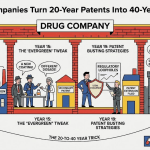
Evergreening is the practice of filing successive patents on incremental modifications to an approved drug, listing those patents in the Orange Book, and using each new listing to restart or extend the Hatch-Waxman litigation cycle. The term is used loosely in policy debates, but for IP analysts it has a specific technical meaning: the deployment of follow-on patents on salt forms, polymorphs, formulations, dosing schedules, metabolites, enantiomers, and new indications to extend the commercial exclusivity period beyond what the original composition-of-matter patent would have provided.
Evergreening works because each listed patent forces an ANDA applicant to certify against it. Even a commercially weak patent, one that the brand expects to lose in litigation, is valuable if its listing causes a generic manufacturer to delay filing, choose a different challenge profile, or settle earlier on less favorable terms. The asymmetric cost structure of Hatch-Waxman litigation means that even a patent with a 30% probability of surviving challenge is worth listing: the brand gets a potential 30-month stay on filing, and it can seek to settle at a low cost before trial reaches its most uncertain phase.
The Taxonomy of Evergreening Patents by Challenge Risk
Polymorph and Salt Form Patents
After a composition-of-matter patent expires on an active ingredient, manufacturers frequently hold patents on specific crystalline polymorphs or salt forms of that ingredient. The commercial theory is that a particular polymorph may have superior bioavailability, stability, or processability, and that the generic must use the same polymorph to achieve bioequivalence. In practice, many polymorph patents face high challenge risk. PTAB has cancelled the claims of multiple pharmaceutical polymorph patents on prior art and obviousness grounds. The Federal Circuit’s decision in Hoffmann-La Roche v. Apotex established that obvious-to-try analysis applies rigorously to polymorph patents when prior art discloses the amorphous form and motivation to crystallize. Generic manufacturers challenging polymorph patents should file IPR petitions against them as a first step, often ahead of or concurrent with district court proceedings.
Formulation and Delivery System Patents
Patents covering drug product formulations, including controlled-release matrices, film-coating compositions, and specific excipient ratios, are the most commercially important evergreening tool after composition-of-matter patents. A well-drafted formulation patent can be genuinely difficult to design around: if the brand’s product uses a specific extended-release matrix that is functionally necessary for the approved pharmacokinetic profile, a generic using a different matrix must conduct bioequivalence studies to show that its release profile meets FDA specifications, and those studies may fail.
The design-around analysis for formulation patents requires pharmaceutical formulation expertise that is distinct from legal claim-scope analysis. Orange Book intelligence teams should maintain in-house formulation scientists or access to contract consultants who can assess whether a challenged formulation patent is truly a technical barrier or a paper barrier. A formulation patent on a specific polymer concentration range may be designed around with a 10% concentration adjustment that passes bioequivalence testing. A formulation patent that covers the only release mechanism capable of producing the required dissolution profile is a genuine barrier.
Method-of-Use Patents and Label Carve-Outs
Method-of-use patents have become a primary evergreening tool, particularly for drugs approved for multiple indications. The brand lists method-of-use patents covering each approved indication. Generic applicants seeking entry on the primary indication must either challenge the method-of-use patents through Paragraph IV or file skinny labels omitting the patented indications. The FDA’s practice of accepting skinny labels has created a substantial opportunity for generic entry on non-patented uses even while brand method-of-use patents remain valid.
The GlaxoSmithKline v. Teva carvedilol litigation complicated the skinny label calculus. The key lesson for generic manufacturers is that skinny labeling is a necessary but not sufficient condition for avoiding infringement liability. The generic’s commercial communications, including sales force materials, promotional websites, and co-pay assistance program language, must consistently reinforce that the generic is approved only for the carved-out indications. Compliance requires ongoing commercial monitoring, not just a one-time label design exercise.
Pediatric Exclusivity as a Regulatory Evergreening Tool
Pediatric exclusivity is not technically an evergreening patent strategy, but it functions as one in practice. By conducting a pediatric study under a Written Request from the FDA, a brand manufacturer earns six months appended to any existing exclusivity or patent protection, including PTE-extended patents. For a product with a $2.5 billion annual U.S. market, this extension is worth approximately $1.25 billion in preserved brand revenue, all for clinical work that may cost $15-50 million to complete. The return on investment is among the highest of any pharmaceutical development activity.
Orange Book exclusivity data identifies products with active PED. Generic entry models must check for outstanding Written Requests and pending Pediatric Safety Reports to determine whether a PED is likely to be granted. The FDA publishes lists of issued Written Requests and pediatric study completion notifications, providing enough lead time for competitors to adjust their ANDA filing timelines.
The Patent Thicket Quantification Framework
A patent thicket is not defined by patent count alone. A drug with 20 listed patents, all covering the same polymorph with overlapping claims, presents a weaker thicket than a drug with 8 patents covering the active ingredient, two distinct formulations, three non-overlapping methods of use, and a device patent. The relevant metric is independent claim scope coverage, defined as the number of distinct technical barriers that a generic applicant must clear to bring a bioequivalent product to market.
The NBER Orange Book Dataset documented an average of 2.5 patents per approved NDA in its sample period (1985-2016), but this average masks substantial heterogeneity. Top-quartile drugs by market capitalization carried 10-15 listed patents at peak, reflecting deliberate portfolio construction strategies. Competitive intelligence teams building patent thicket assessments should score each patent by its independent claim scope (broad = high barrier), prosecution history (clean = high validity confidence), PTE status, and any outstanding PTAB or district court proceedings.
Key Takeaways: Evergreening
Evergreening is commercially rational under the Hatch-Waxman framework because the asymmetric cost of litigation makes even weak patents worth listing. Competitive intelligence must assess patent validity, not just patent existence.
Polymorph and salt form patents face systematically higher PTAB cancellation rates than composition-of-matter or formulation patents. They are high-priority IPR targets for generic challengers.
Skinny label carve-outs are valid under FDA regulations but require active commercial compliance monitoring post-launch to avoid induced infringement claims under the GSK v. Teva framework.
Pediatric exclusivity extensions are high-ROI evergreening tools generating approximately $1.2 billion per six-month extension for a $2.5 billion product. Generic entry models that omit pediatric Written Request tracking will underestimate brand exclusivity duration.
Investment Strategy: Evergreening Analysis
For buy-side analysts covering brand pharmaceutical companies, the quality of evergreening execution is a key determinant of long-term revenue sustainability. A company that consistently files formulation and method-of-use patents well before composition-of-matter expiry, maintains pediatric Written Request programs, and constructs overlapping patent coverage across technical dimensions is materially more defensible than one relying on a single composition patent with a clean expiry cliff.
Conversely, for short-sellers or investors modeling revenue deterioration, the gap between a drug’s nominal last-patent-expiry and its actual independent-claim-scope coverage is the most reliable indicator of how early generic entry will actually occur. Drugs with nominal 2030 expiry dates but weak formulation patents and no PTE, facing five co-pending Paragraph IV challenges from well-capitalized generic filers, may experience effective competition in 2027.
Section 7: Generic Market Entry Timing: How Orange Book Data Drives ANDA Strategy
The ANDA Development Timeline and Orange Book Inputs
A full ANDA development program for an oral solid dosage form typically spans 24-36 months from API procurement through bioequivalence study completion and FDA submission. For complex dosage forms, including extended-release products, transdermal patches, and inhaled products, development timelines extend to 36-60 months. This means that a generic manufacturer must identify its target product and begin development 2-5 years before anticipated market entry, which requires forward-looking Orange Book analysis at time of program initiation.
The target identification process evaluates several Orange Book-derived inputs simultaneously. The analyst must project the earliest possible ANDA approval date, which is the later of the last regulatory exclusivity end-date and the date on which all patent certifications are resolved. The analyst must estimate the number of competing ANDA filers, which determines whether 180-day first-filer exclusivity is available and how quickly the market will reach multi-source competition pricing. The analyst must also assess the probability that Paragraph IV litigation will result in early entry or require waiting until full patent expiry.
Revenue Erosion Curves: What the Data Actually Shows
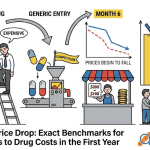
The standard industry model for generic price erosion is more granular than the “70-80% volume capture in year one” summary that appears in most overview documents. The actual erosion pattern depends critically on the number of generic entrants and the timing of their entry. During a 180-day first-filer exclusivity period, the sole generic typically captures 60-75% of branded prescription volume at an average selling price 20-30% below brand. The brand retains the remainder primarily through patient adherence programs, formulary positioning, and physician preference prescribing.
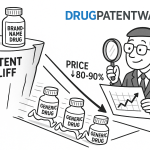
At 180-day exclusivity expiration, when the FDA can approve additional ANDAs, the price dynamics shift rapidly. The entry of a second generic pushes average generic prices to roughly 50-60% of brand. By the time five or more generics compete, average generic prices typically fall to 15-25% of the original brand price. The brand’s revenue declines to 10-20% of pre-generic levels within 24-36 months of multi-source competition. Revenue modeling that applies a single average erosion curve rather than a number-of-entrants-conditional curve will systematically over-estimate brand revenue in the post-LOE period.
Orange Book Monitoring Infrastructure for Generic Filers
Generic manufacturers maintain Orange Book monitoring systems designed to capture four categories of commercially actionable signals. First, patent expiry alerts for high-value products as their exclusivity windows approach. Second, new patent listings that could extend a previously clean expiry profile. Third, exclusivity code changes that modify the ANDA approval timeline. Fourth, existing first-filer positions held by competitors, which can be partially inferred from public ANDA approval action letters, 180-day exclusivity forfeitures, and court documents in ongoing Paragraph IV cases.
The most sophisticated systems supplement the FDA’s daily-updated Orange Book with patent analytics from the USPTO, PTAB docket monitoring, district court Hatch-Waxman docket scanning, and FTC settlement filings. This multi-source integration allows near-real-time competitive positioning analysis: when a competitor settles a Paragraph IV case with an authorized entry date three years earlier than last-patent-expiry, that settlement implies the brand has weak IP, which may make the product more attractive for additional ANDA filers who previously deferred entry due to perceived patent risk.
Key Takeaways: Generic Entry Timing
ANDA development lead times of 24-60 months require Orange Book analysis at program initiation, not at filing. A product that looks clean in year N-1 may carry new patent listings by the time an ANDA is ready to file in year N+2.
Revenue erosion curves are entrant-count-conditional, not time-conditional. Models that apply fixed erosion rates without accounting for expected entrant count overestimate post-LOE brand revenue and underestimate generic revenue per entrant.
Competitor first-filer positions are partially reconstructible from public litigation records and settlement disclosures. They are among the most important strategic variables in ANDA portfolio planning and are not visible from Orange Book data alone.
Section 8: Advanced Orange Book Analytics: Patent Landscaping, Competitive Positioning, and Predictive Modeling
Patent Landscaping in the Pharmaceutical Context
Patent landscaping for pharmaceutical competitive intelligence differs from the technology-sector version because the Orange Book provides a pre-filtered, commercially relevant patent set. Rather than searching broad patent classification systems and filtering down to commercially relevant patents, the pharmaceutical analyst starts from Orange Book listings and expands outward to related patent families, citation networks, and USPTO prosecution histories. This inversion of the standard landscaping workflow is more efficient for product-specific analysis and more aligned with the commercial questions that drug teams actually need to answer.
A complete landscape analysis for a single drug product would proceed through several distinct analytical layers. At the core is the Orange Book-listed patent set, mapped by patent flag type and expiry. The next layer is the full patent family for each listed patent, including international equivalents filed in the EPO, WIPO, Japanese, and Chinese patent offices, which reveal the brand’s geographic protection strategy and any prosecution differences that could affect claim validity in the U.S. The outermost layer is the competitive landscape of patents in the same therapeutic area held by other manufacturers, which identifies the white space for next-generation product development and alternative mechanisms of action.
Competitive Positioning Analysis Using Orange Book Cohorts
Therapeutic area-level analysis is most powerful when conducted across a full competitive set rather than for a single drug. By building an Orange Book cohort for all approved drugs in a category, such as PDE5 inhibitors, GLP-1 receptor agonists, or oral JAK inhibitors, an analyst can map the full timeline of exclusivity expirations across the category, identify clustering of multiple LOE events that will create intense multi-product generic competition, and detect asymmetries where one product has substantially stronger IP protection than competitors with similar clinical profiles.
GLP-1 receptor agonists are the most commercially significant current example of a category requiring this cohort analysis. Ozempic (semaglutide injection) and Wegovy (semaglutide for weight management), both approved under Novo Nordisk NDAs, carry distinct Orange Book patent profiles. Rybelsus (oral semaglutide) has additional formulation patents covering its absorption enhancer technology. Mounjaro and Zepbound (tirzepatide), approved under Eli Lilly NDAs, carry Lilly’s own composition and formulation patent estate. Competitive intelligence teams modeling the GLP-1 generic entry timeline must analyze each product’s Orange Book patents separately, then overlay them to identify the multi-year window during which the entire category will face simultaneous generic pressure.
Orange Book patent challenge outcomes have a documented historical record extending to the late 1980s, which makes them viable training data for supervised machine learning models. Several academic and commercial research programs have developed predictive models for Paragraph IV litigation outcomes using features derived from patent characteristics, prosecution history, litigation venue, challenger identity, and prior related litigation results. These models do not replace legal judgment, but they provide quantitative baselines for challenge probability estimates that are more rigorous than analyst intuition.
The primary commercial applications of predictive modeling in Orange Book intelligence include three specific use cases. First, for generic manufacturers, models can rank ANDA challenge candidates by probability-weighted first-filer NPV, incorporating both the challenge probability and the expected revenue if entry is achieved. Second, for brand manufacturers, the same models can identify which listed patents face the highest challenge risk, prioritizing IP reinforcement investment or settlement authorization decisions. Third, for investors and acquirers, probabilistic exclusivity models enable scenario-weighted DCF valuations that more accurately capture the distribution of revenue outcomes than single-scenario models.
Historical Trend Analysis: What the NBER Dataset Reveals
The NBER Orange Book Dataset, which merged print editions from 1985-1999 with digital data through 2016, provides the most comprehensive historical view of Orange Book listing strategies and their commercial outcomes available in the academic literature. Several empirically validated patterns from this dataset should inform current competitive intelligence practice. Active ingredient (DS) patents received PTE in 79% of cases in the sample, compared with 13% for other patent types, confirming that manufacturers systematically prioritize PTE for their highest-value IP. The dataset also documents that the average number of patents per NDA increased substantially across the sample period, consistent with the diffusion of evergreening strategies into routine lifecycle management practice from the mid-1990s onward.
When comparing Orange Book-listed patents to the broader IQVIA/Ark Patent Intelligence database, researchers found that the Orange Book captures the large majority of commercially constraining patents. The overlap analysis identified that 75% of patents flagged by IQVIA/Ark as constraining generic entry for a given drug also appear in the Orange Book. The 25% that do not appear are primarily manufacturing process patents, intermediate patents, and formulation patents that do not technically claim the approved drug product. These non-listed patents still present competitive considerations but require separate monitoring outside the Orange Book framework.
Key Takeaways: Advanced Analytics
Orange Book-centric patent landscaping is more efficient for pharmaceutical product analysis than top-down classification-based landscaping, because it starts from the commercially filtered patent set.
GLP-1 receptor agonist Orange Book analysis requires cohort-level modeling across multiple NDA holders to capture the full multi-year exclusivity cliff risk facing the category.
Machine learning models trained on historical Paragraph IV outcomes provide quantitative challenge probability estimates that improve on analyst intuition for high-volume ANDA pipeline prioritization decisions.
The NBER dataset validates that 75% of commercially constraining pharmaceutical patents appear in the Orange Book, but the 25% that do not (process, intermediate, and packaging patents) require independent monitoring and can still present material competitive barriers.
Section 9: The FTC’s Orange Book Challenge Campaign and the Evolving Regulatory Landscape
The 2022-2025 FTC Enforcement Initiative
The FTC’s campaign against improper Orange Book listings, which began formally with a 2022 amicus brief in the Sanofi v. Accord Healthcare litigation and escalated to a direct administrative challenge of more than 100 patents in November 2023, represents the most significant structural change to the Orange Book’s competitive role since the 2003 Medicare Modernization Act eliminated multiple 30-month stays.
The FTC’s specific theory is that patents on drug delivery devices, including auto-injectors, inhalers, and prefilled syringes, do not claim the approved drug product within the meaning of 21 C.F.R. 314.53(b). The relevant statutory standard requires that a listable patent “claims the drug or a method of using the drug.” A patent that claims the mechanical design of an auto-injector, the FTC argued, claims the delivery device, not the drug. The administrative challenge triggered the FDA’s orange book dispute resolution process, under which the NDA holder must affirmatively defend the propriety of the listing or the patent is removed.
By mid-2024, the FTC’s challenge had produced a mixed but still commercially significant scorecard. Several manufacturers, including AstraZeneca and Amneal, withdrew some challenged device patents rather than contest the delisting process. Other challenges remained pending in district court, with brand manufacturers arguing that integrated drug-device combination products qualify the device patents for Orange Book listing because the device is part of the approved product. The Federal Circuit’s December 2024 decision in one related case, Teva v. Amneal Pharmaceuticals, added further complexity by distinguishing between patents covering the device alone and patents covering the drug-device combination as an integrated product.
Legislative Pressure and the PDRMA Framework
Congressional scrutiny of Orange Book listing practices has intensified alongside the FTC’s enforcement activity. The PDRMA (Pharmaceutical Drug Reforms for More Availability), introduced in the Senate in 2023, would have codified stricter listability standards and created a faster administrative dispute process for patent delisting challenges. While the bill did not pass in its original form, its provisions influenced the FDA’s informal guidance on listing standards and demonstrated that legislative risk to the current ministerial listing framework is not negligible.
For Orange Book intelligence purposes, legislative risk is a non-standard but material variable. A statutory change that tightened listability standards for device patents would immediately reduce the effective IP protection of hundreds of drug-device combination products currently listed in the Orange Book. Portfolios heavily weighted toward device patents, without strong underlying drug substance or formulation protection, are exposed to this regulatory risk in a way that purely patent-based analysis does not capture.
Key Takeaways: Regulatory Evolution
The FTC’s 2022-2025 delisting campaign has created a functional administrative challenge mechanism for Orange Book device patents that previously did not exist in practice. Brand IP portfolios carrying device patents should be stress-tested against delisting scenarios.
The ministerial listing standard remains the legal baseline but faces active erosion from both FTC enforcement and potential legislative reform. Any brand IP strategy that relies heavily on device-drug combination patents needs a contingency plan for post-delisting exclusivity.
The Federal Circuit’s ongoing case law development on what constitutes a patent claiming “the drug” versus “the device” will shape the legal boundary of valid Orange Book listings for the next decade. Analysts should track these decisions as they produce material changes to the competitive moat of affected drug-device products.
Section 10: The Biologics Blind Spot: Purple Book vs. Orange Book
Why the Orange Book Does Not Cover Biologics
Biologic drugs, approved under Biologics License Applications (BLAs) pursuant to the Public Health Service Act, fall entirely outside the Orange Book framework. Congress created a distinct regulatory pathway for biosimilar competition through the Biologics Price Competition and Innovation Act of 2010 (BPCIA), which established a separate exclusivity and patent resolution framework that operates entirely outside the Hatch-Waxman/Orange Book system. The FDA’s Purple Book is the analog resource for biologics, listing BLA-approved products, their 12-year reference product exclusivity periods, and any four-year bar on 351(k) biosimilar application submissions.
The absence of biologics from the Orange Book is a structurally significant limitation for competitive intelligence purposes, because biologics represent the fastest-growing segment of pharmaceutical revenue. Eight of the top ten drugs by U.S. net revenue in 2024 are biologics, and the first wave of major biologic patent expirations, covering adalimumab, trastuzumab, bevacizumab, and related products, has already generated commercially significant biosimilar entries.
The BPCIA Patent Dance vs. Orange Book Litigation
The BPCIA’s patent resolution mechanism, which practitioners call the “patent dance,” differs from the Orange Book litigation model in several important ways. Under the patent dance, the biosimilar applicant voluntarily shares its manufacturing process information with the reference product sponsor. The sponsor then identifies patents it believes would be infringed, and the parties engage in a negotiated process to identify which patents will be litigated in a “launch litigation” and which will be deferred to an “patent resolution” phase after biosimilar launch. Participation in the patent dance is voluntary for the biosimilar applicant. The Supreme Court held in Amgen v. Sandoz in 2017 that a biosimilar applicant could choose not to participate, but this decision also clarified that the 180-day notice before commercial marketing still applies regardless of dance participation.
The patent dance produces no equivalent to the Orange Book’s public patent listing. There is no public registry of which biologic patents are being asserted, which have been licensed, or which expiry dates define the commercial exclusivity runway. This opacity dramatically increases the research burden for competitive intelligence teams covering biologic markets. Information must be reconstructed from litigation filings, settlement announcements, FDA Purple Book exclusivity listings, and company disclosures. This is substantially less efficient than the Orange Book framework for small molecules.
Biosimilar Interchangeability: The Functional Equivalent of AB Rating
The Purple Book’s closest functional analog to the Orange Book’s AB therapeutic equivalence rating is the biosimilar interchangeability designation. A biosimilar rated as interchangeable by the FDA may be substituted for the reference biologic at the pharmacy level without physician intervention, in states that have enacted biosimilar substitution laws. As of 2025, all 50 states have enacted some form of biosimilar substitution legislation.
Biosimilar interchangeability is significantly harder to achieve than AB rating for a small-molecule generic. The applicant must conduct switching studies demonstrating that patients alternating between the biosimilar and the reference product do not experience greater safety or efficacy risks than patients remaining on the reference product. As of early 2025, approximately 12 biosimilars held interchangeability designations, out of more than 50 FDA-approved biosimilars. The commercial significance of interchangeability is highest in the insulin and long-acting growth hormone markets, where pharmacy-level substitution drives volume adoption without requiring payer formulary redesign.
Key Takeaways: Biologics and the Purple Book
The Orange Book does not cover biologics. Any competitive intelligence function covering the full pharmaceutical market requires a separate Purple Book monitoring capability for BLA-approved products and biosimilar 351(k) applications.
The BPCIA patent dance produces no public patent listing equivalent. Biologic IP analysis requires litigation-based reconstruction of the patent landscape, which is substantially more labor-intensive than Orange Book analysis.
Biosimilar interchangeability is the functional equivalent of AB rating for pharmacy substitution purposes. Monitoring interchangeability designation applications is a leading indicator of formulary access potential for biosimilar products.
Section 11: Data Tools and Competitive Intelligence Infrastructure
The FDA’s Electronic Orange Book: Capabilities and Limitations
The FDA provides the Electronic Orange Book at no cost through its website, updated daily with new patent listings, exclusivity grants, and product approvals. The database is searchable by active ingredient, proprietary name, applicant, NDA number, dosage form, route of administration, and patent number. For point-in-time lookups and basic product surveillance, it is entirely adequate. For competitive intelligence programs requiring historical tracking, cross-product analysis, integration with other data sources, and automated alerting, it has significant structural limitations.
The FDA’s interface does not maintain historical records of changes: a patent that was listed and then delisted does not leave a visible trace in the current electronic database. The data structure is not optimized for bulk export or API integration. Search results are product-centric rather than patent-centric, making it difficult to identify all products protected by a specific patent family without manual cross-referencing. For serious competitive intelligence work, these limitations make the FDA database a validation source rather than a primary analytical platform.
Commercial Orange Book Intelligence Platforms
Several commercial vendors have built platforms that address the FDA database’s limitations for competitive intelligence purposes. DrugPatentWatch maintains a patent expiration monitoring and alert platform that integrates Orange Book data with USPTO patent records, ANDA approval action letters, and Paragraph IV litigation dockets. Derwent Innovation and Cortellis (Clarivate) provide integrated pharmaceutical patent intelligence platforms that connect Orange Book listings to full patent family data, prosecution history, and citation analysis. IQVIA’s Evaluate Pharma and GlobalData provide commercial analytics that incorporate Orange Book-based exclusivity modeling into market forecasting products.
Platform selection depends on the specific use case. For pure IP monitoring and litigation tracking, specialized legal intelligence platforms with deep ANDA docket coverage, such as Orange Book Blog’s Hatch-Waxman litigation database, offer more granular case-level data than general pharmaceutical analytics platforms. For financial modeling, platforms that integrate Orange Book exclusivity timelines directly into revenue projection models, with built-in scenario modeling for patent challenge outcomes, provide the most direct path from data to investment-grade forecasts.
Building a Custom Orange Book Intelligence Stack
Organizations with sophisticated competitive intelligence requirements increasingly build proprietary data stacks that combine the FDA’s Orange Book data, accessed via the FDA’s Orange Book Data Files download, with USPTO patent data through the PatentsView API, PTAB proceedings through the PTAB API, ANDA approval information from FDA Drugs@FDA, and Hatch-Waxman litigation data from PACER or commercial litigation databases. This custom stack approach requires ongoing data engineering investment but delivers intelligence workflows tailored to specific organizational needs.
Key technical requirements for a custom Orange Book intelligence stack include a data ingestion pipeline that captures daily FDA Orange Book updates and flags changes from the prior version, a patent matching algorithm that links Orange Book patent numbers to full USPTO records, a PTAB monitoring module that tracks IPR petitions against listed patents, and an alerting system that routes changes to relevant teams based on pre-configured product watchlists. The stack should maintain full historical snapshots of Orange Book data, not just current state, because historical change analysis is often as valuable as current status for competitive pattern recognition.
Data Quality and Validation Protocols
Given the FDA’s ministerial listing standard, Orange Book data carries inherent accuracy risk that requires validation protocols. The most common validation issue is patent scope mismatch: a listed patent that does not actually claim the approved drug product or method of use as described in the label. Identifying these mismatches requires claim-by-claim analysis of each listed patent against the approved product characteristics, work that requires patent legal expertise rather than data engineering.
A second validation concern is patent expiry date accuracy. Base patent terms are deterministic from the USPTO filing date and issue date, but PTE adjustments require separate USPTO records that are not always reflected in the Orange Book with perfect timeliness. Any Orange Book intelligence system should independently verify PTE adjustments for all listed patents from USPTO PTE grant records, not rely solely on the Orange Book expiry date field.
Key Takeaways: Tools and Infrastructure
The FDA’s Electronic Orange Book is the authoritative data source for current listings but lacks historical change tracking, bulk export, and API integration necessary for sophisticated competitive intelligence programs.
Commercial platform selection should align with primary use case: legal intelligence platforms for litigation tracking, financial analytics platforms for revenue modeling, and integrated patent platforms for IP portfolio analysis.
Custom Orange Book intelligence stacks combining FDA data with USPTO, PTAB, and litigation sources provide the most complete coverage but require ongoing data engineering investment.
Patent expiry date validation against USPTO PTE grant records is a required data quality step. Orange Book expiry dates without independent PTE verification are unreliable for near-term exclusivity modeling.
Section 12: Investment Strategy for Pharmaceutical Analysts
Building an Orange Book-Based Coverage Framework
For institutional investors covering pharmaceutical and biotech equities, Orange Book analysis should be a standard component of coverage initiation and ongoing monitoring. At coverage initiation, analysts should build a comprehensive exclusivity model for every product contributing more than 10% of company revenue, incorporating all listed patents by type and expiry, PTE adjustments, regulatory exclusivity end dates, outstanding Paragraph IV challenges and their settlement status, and probabilistic generic entry timing under at least three scenarios (early entry, mid-range entry, and full-exclusivity scenario).
This model does not replace standard financial analysis, but it provides a structurally grounded basis for revenue projections that substantially outperforms extrapolating management guidance or consensus estimates. Management teams have well-documented incentives to present optimistic LOE timelines. An independent Orange Book model with conservative challenge probabilities will, on average, produce earlier generic entry dates and lower revenue estimates than company-provided guidance.
Orange Book Signals as Leading Indicators
Several Orange Book-derived signals have predictive value for forward-looking investment analysis. First, the filing of Paragraph IV certifications against a brand company’s flagship product is a predictive signal for both litigation cost increases and, if multiple filers appear within a short window, potential early generic entry. Multiple co-pending Paragraph IV challenges typically signal that patent strength is in question across the generic industry, even if individual challenge filings are not yet public.
Second, settlements granting generic entry significantly earlier than last-patent-expiry are a direct signal that the brand’s IP is weaker than its nominal patent coverage suggests. When a company settles a Paragraph IV challenge with an authorized entry date four years before last-patent-expiry for a $1.5 billion product, the NPV implication is a roughly $6 billion reduction in brand revenue that may not be fully priced into consensus estimates if the settlement is treated as a one-time litigation event rather than an IP quality signal.
Third, new patent listings for an aging drug deserve scrutiny rather than automatic credit. A patent listed in the Orange Book five years before a product’s primary composition patent expires may genuinely extend the exclusivity runway, or it may be an evergreening attempt that a well-resourced generic challenger will invalidate quickly at PTAB. Assigning full exclusivity value to new listings without assessing their claim quality overstates brand IP durability.
Short and Long Frameworks Using Orange Book Data
A long framework anchored in Orange Book analysis would target brand companies whose effective patent life on core products is materially longer than consensus models suggest, perhaps because their patent thicket quality is consistently undervalued by analysts who count patents rather than assess claims, or because outstanding PTE applications are not yet captured in Street models. Companies with deep pediatric exclusivity pipelines generating PED extensions on multiple products are systematically undervalued in analyses that focus solely on composition patent expiry.
A short framework would target brand companies whose nominal exclusivity runways are significantly overstated because key listed patents face high PTAB or Paragraph IV challenge risk, or because device patents in their portfolio are under active FTC delisting review. Combining an Orange Book-based effective patent life analysis with a PTAB petition monitoring database can identify products where the consensus LOE date is 2-4 years earlier than the market assumes, a discrepancy that has historically been one of the most reliable sources of alpha in pharmaceutical equity analysis.
Key Takeaways: Investment Strategy
Coverage initiation for pharma equities should include a bottom-up Orange Book exclusivity model for all material revenue contributors, with probability-weighted generic entry scenarios rather than single-point LOE dates.
Paragraph IV filings and early settlement authorized entry dates are leading indicators of IP quality problems that often precede consensus LOE estimate revisions by 12-24 months.
Companies with deep PED pipelines and high-quality evergreening patent coverage are systematically undervalued by count-based patent analysis. Companies with device-heavy Orange Book portfolios face underappreciated delisting risk.
The most durable alpha in pharmaceutical equity analysis comes from building rigorous IP-adjusted revenue models earlier than consensus. Orange Book data, combined with PTAB monitoring and litigation tracking, provides the foundation for this analytical edge.
Conclusion: Orange Book Intelligence as a Core Competency
The Orange Book is forty-five years old. It has survived the biologics revolution by remaining the authoritative registry for small-molecule drug IP, even as it has become increasingly inadequate for a market where biologics generate more than half of total pharmaceutical industry revenue. It has survived multiple rounds of proposed legislative reform, FTC enforcement campaigns, and PTAB-era patent uncertainty by retaining its central function in the Hatch-Waxman litigation architecture. That architecture will not disappear. The commercial incentives on both the brand and generic sides are too powerful, and the regulatory framework is too deeply embedded in FDA approval mechanics, to expect a wholesale replacement.
What will change, and is already changing, is the sophistication required to use Orange Book data effectively. A simple patent expiry calendar was adequate for competitive intelligence in 1990. By 2025, the combination of multi-layer patent thickets, FTC delisting risk, PTAB parallel proceedings, skinny label litigation complexity, and increasingly predictive ML analytics has made Orange Book intelligence a specialist discipline requiring legal, scientific, and quantitative capabilities working in concert.
Organizations that treat Orange Book analysis as a research task to be delegated to paralegals or junior analysts, rather than a core strategic intelligence function, will consistently find themselves behind on LOE timelines, surprised by Paragraph IV challenges they could have anticipated, and unable to quantify the IP risk embedded in M&A targets at the speed that deal timelines require. The data is public. The analytical frameworks exist. The competitive advantage belongs to those who deploy them systematically.
About This Analysis
This pillar page was produced for pharmaceutical and biotech IP teams, R&D strategy functions, and institutional investors. Data references are drawn from the FDA Electronic Orange Book, the NBER Orange Book Dataset (Sampat, Bhaven N. et al., PMC10731339), Congressional Research Service report IF12644, USPTO PTE records, and publicly available Hatch-Waxman litigation filings. All financial estimates are illustrative models based on published industry benchmarks and should not be relied upon as investment advice.