Last Updated: August 7, 2026

EFFEXOR XR Drug Patent Profile


✉ Email this page to a colleague

« Back to Dashboard


Which patents cover Effexor Xr, and what generic alternatives are available?

Effexor Xr is a drug marketed by Upjohn and is included in one NDA.

The generic ingredient in EFFEXOR XR is venlafaxine hydrochloride. There are seventy-one drug master file entries for this compound. Sixty-three suppliers are listed for this compound. Additional details are available on the venlafaxine hydrochloride profile page.

AI Deep Research
Questions you can ask:
  • What is the 5 year forecast for EFFEXOR XR?
  • What are the global sales for EFFEXOR XR?
  • What is Average Wholesale Price for EFFEXOR XR?
Recent Clinical Trials for EFFEXOR XR

Identify potential brand extensions & 505(b)(2) entrants

SponsorPhase
Mit Ghamr Oncology CenterPhase 4
Vanderbilt University Medical CenterPhase 4
AbbViePhase 4

See all EFFEXOR XR clinical trials

Paragraph IV (Patent) Challenges for EFFEXOR XR
Tradename Dosage Ingredient Strength NDA ANDAs Submitted Submissiondate
EFFEXOR XR Extended-release Tablets venlafaxine hydrochloride 37.5 mg, 75 mg and 150 mg 020699 1 2007-05-03

US Patents and Regulatory Information for EFFEXOR XR

Applicant Tradename Generic Name Dosage NDA Approval Date TE Type RLD RS Patent No. Patent Expiration Product Substance Delist Req. Exclusivity Expiration
Upjohn EFFEXOR XR venlafaxine hydrochloride CAPSULE, EXTENDED RELEASE;ORAL 020699-001 Oct 20, 1997 AB RX Yes No ⤷  Start Trial ⤷  Start Trial ⤷  Start Trial
Upjohn EFFEXOR XR venlafaxine hydrochloride CAPSULE, EXTENDED RELEASE;ORAL 020699-004 Oct 20, 1997 AB RX Yes Yes ⤷  Start Trial ⤷  Start Trial ⤷  Start Trial
Upjohn EFFEXOR XR venlafaxine hydrochloride CAPSULE, EXTENDED RELEASE;ORAL 020699-002 Oct 20, 1997 AB RX Yes No ⤷  Start Trial ⤷  Start Trial ⤷  Start Trial
Upjohn EFFEXOR XR venlafaxine hydrochloride CAPSULE, EXTENDED RELEASE;ORAL 020699-003 Oct 20, 1997 DISCN Yes No ⤷  Start Trial ⤷  Start Trial ⤷  Start Trial
>Applicant >Tradename >Generic Name >Dosage >NDA >Approval Date >TE >Type >RLD >RS >Patent No. >Patent Expiration >Product >Substance >Delist Req. >Exclusivity Expiration

Expired US Patents for EFFEXOR XR

Applicant Tradename Generic Name Dosage NDA Approval Date Patent No. Patent Expiration
Upjohn EFFEXOR XR venlafaxine hydrochloride CAPSULE, EXTENDED RELEASE;ORAL 020699-001 Oct 20, 1997 ⤷  Start Trial ⤷  Start Trial
Upjohn EFFEXOR XR venlafaxine hydrochloride CAPSULE, EXTENDED RELEASE;ORAL 020699-004 Oct 20, 1997 ⤷  Start Trial ⤷  Start Trial
Upjohn EFFEXOR XR venlafaxine hydrochloride CAPSULE, EXTENDED RELEASE;ORAL 020699-002 Oct 20, 1997 ⤷  Start Trial ⤷  Start Trial
>Applicant >Tradename >Generic Name >Dosage >NDA >Approval Date >Patent No. >Patent Expiration

International Patents for EFFEXOR XR

See the table below for patents covering EFFEXOR XR around the world.

Country Patent Number Title Estimated Expiration
Austria 28628 ⤷  Start Trial
Australia 2212383 ⤷  Start Trial
Australia 567524 ⤷  Start Trial
Bulgaria 60659 ⤷  Start Trial
Canada 1248540 DERIVES DE PHENETHYLAMINE, ET INTERMEDIAIRES CONNEXES (PHENETHYLAMINE DERIVATIVES AND INTERMEDIATES THEREFOR) ⤷  Start Trial
>Country >Patent Number >Title >Estimated Expiration

Supplementary Protection Certificates for EFFEXOR XR

Patent Number Supplementary Protection Certificate SPC Country SPC Expiration SPC Description
0112669 96C0002 Belgium ⤷  Start Trial PRODUCT NAME: MOMETASONE FUROATE; NAT. REGISTRATION NO/DATE: NL 19601 19950919; FIRST REGISTRATION: GR - 10681/89 19900622
>Patent Number >Supplementary Protection Certificate >SPC Country >SPC Expiration >SPC Description

Effexor XR (venlafaxine extended-release) Market Dynamics and Financial Trajectory: Sales Trends, Competitive Pressures, and Exclusivity/PAR IV Risk

Last updated: July 30, 2026

Effexor XR (venlafaxine extended-release; Pfizer) remains a mature antidepressant franchise in a heavily genericized CNS market. With patent life long expired, the commercial trajectory is driven by generic pricing, channel mix, formulary placement, and switching pressure from SSRIs/SNRIs and newer branded options where available (primarily via payer policies rather than IP leverage).

When did Effexor XR lose brand exclusivity, and when could generics broadly launch?

Short answer: Effexor XR’s branded exclusivity has long ended; the market is now dominated by generics and authorized generics with ongoing price compression rather than IP-driven blockades.

What does the exclusivity picture typically look like for Effexor XR?

  • Effexor XR is an established small-molecule SNRI (venlafaxine).
  • For drugs at this maturity, market entry is generally shaped by:
    • Generic ANDA launches after patent expiry.
    • 180-day exclusivity for first Paragraph IV filers (if applicable), followed by multi-entrant saturation.
    • State and PBM formulary policies rather than patent-backed barriers.

How do exclusivity dynamics change in a fully generic environment?

Once branded exclusivity and key patents lapse, the market’s “timeline” becomes:

  • Near-term: Rapid generic entry and downward list-price behavior.
  • Mid-term: PBM-driven rebates stabilize “net” prices, with periodic further erosion.
  • Long-term: Brand share often becomes residual unless a payer carveout or specialty channel preserves it.

What is the current Orange Book status of Effexor XR (venlafaxine ER)?

Short answer: Effexor XR is not protected by meaningful, currently enforceable brand exclusivity in the way it would block generic competition.

What typically drives Orange Book listings for an older SNRI like Effexor XR?

  • Legacy formulation and method patents may still be listed historically, but the commercial blocker in a saturated market is usually:
    • Whether there are still enforceable patents covering specific strengths, dosage forms, or manufacturing/process.
    • Whether generic entrants have established bioequivalence across strengths without design-arounds.
  • In practice, payers and wholesalers focus on:
    • Lowest net cost.
    • Supply continuity.
    • Margin considerations across generics and authorized generics.

How has the competitive landscape evolved for Effexor XR versus SSRIs and other SNRIs?

Short answer: Effexor XR competes on “therapeutic familiarity” and cost, not differentiation. The dominant substitution set is other antidepressants, especially generic SSRIs and SNRIs.

Which drug classes pressure Effexor XR?

  • Generic SSRIs: citalopram, escitalopram, fluoxetine, sertraline.
  • Generic SNRIs: duloxetine (and other ER options where available).
  • Adjunct and alternatives in payer menus:
    • Mirtazapine.
    • Bupropion ER/XL.
    • Tricyclics in specific lines (less used, but still in formularies).

How does substitution happen in practice?

  • Step therapy and formulary tiers move patients away from branded options.
  • Prescribers often switch within SNRI/SSRI classes based on tolerability and side effect profiles.
  • For venlafaxine ER specifically, switching pressure tends to come from:
    • Easier-to-dose or better-tolerated alternatives on payer formularies.
    • Lower total cost pathways (generic SSRIs often outrank SNRIs).

What market dynamics drive Effexor XR revenue now?

Effexor XR revenue is primarily governed by three mechanics: net price erosion, channel mix, and usage stability in chronic depression/anxiety indications.

Net price behavior in a generic-led CNS market

  • List prices become less predictive once multiple generic manufacturers exist.
  • PBM rebates and wholesaler contracting drive “net” cost.
  • Competitive intensity usually keeps net reimbursement low and compresses margins for remaining brand-equivalent SKUs.

Channel mix

  • Effexor XR’s business profile typically depends on:
    • Retail pharmacy share versus mail order.
    • PBM contract specificity by NDC manufacturer.
    • Supply and fill-rate dynamics in generic distribution.

Utilization stability

Even when brand share declines, underlying venlafaxine ER utilization can persist because:

  • Long-term tolerability can create continuity prescribing.
  • Switching antidepressants is clinician- and patient-dependent, especially where stability is achieved.

How does Effexor XR’s financial trajectory compare with other mature antidepressant franchises?

Short answer: Effexor XR’s financial pattern matches other off-patent antidepressants: declining brand revenue, flattish underlying utilization (sometimes), and structurally low pricing power.

Typical financial shape for older branded antidepressants after generic saturation

  • Brand revenue declines over multiple years as:
    • PBM tiering favors generics.
    • Authorized generics further reduce branded demand.
  • Generic utilization absorbs remaining patients, keeping “market” size stable while the “brand” share falls.

What does that imply for investors and licensors?

  • Business value shifts toward:
    • Authorized generic operations and manufacturing scale.
    • Specialty licensing for remaining patent corners (if any).
    • Contracting leverage with PBMs via supply reliability and price.

What financial and revenue outcomes have the major companies likely captured in Effexor XR?

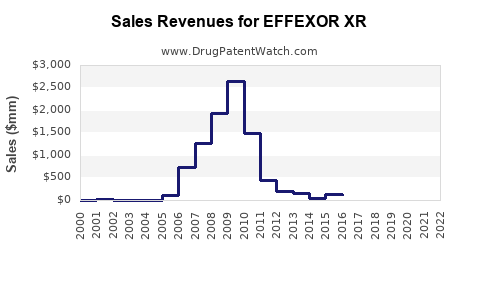
Effexor XR’s branded revenue capture is largely historical; ongoing economics are captured by generic manufacturers and any authorized generic holder(s).

Which revenue streams remain relevant in a mature venlafaxine ER market?

  1. Retail and mail dispensing for generic venlafaxine ER.
  2. Wholesale and rebate-driven net reimbursement flows by PBM.
  3. Any remaining branded or legacy formulations with narrower payer coverage.

What patent litigation and Paragraph IV risk affects Effexor XR now?

Short answer: In a fully genericized product, new Paragraph IV events tend to be sporadic and usually do not materially change the market unless they:

  • Trigger supply disruptions.
  • Restrain specific authorized generic entries.
  • Create settlement terms that delay additional entrants.

What to watch for in later-stage disputes

  • Settlement dates that delay certain NDCs.
  • Injunction outcomes that cause temporary exclusivity-like behavior for a specific strength or manufacturer.
  • Any “late” device or manufacturing process patents that could be asserted against a narrow portion of supply.

How many patents protect Effexor XR, and what types matter commercially?

Short answer: For off-patent small molecules like Effexor XR, the commercial question is less “how many patents exist” and more “are any enforceable today in a way that blocks manufacturing or specific strengths.”

Patent types that can still matter in a mature market

  • Formulation and manufacturing method patents (if enforceable and not designed around).
  • Method-of-use patents are less common as commercial blockers for established antidepressants once generic prescribing is routine.
  • Process patents can matter if a generic must change manufacturing significantly to avoid infringement.

What manufacturing/IP barriers exist for generic venlafaxine ER?

Short answer: For an ER product, the principal barrier tends to be formulation execution and consistent release profile, not novel IP.

Practical manufacturing drivers for ER generics

  • Release control consistency across strengths.
  • Bioequivalence robustness and batch-to-batch uniformity.
  • Particle size distribution, coating and dissolution behavior, and stability.

What is the biosimilar risk for Effexor XR?

Short answer: None. Effexor XR is a small molecule; biosimilar frameworks do not apply.

When does Effexor XR face any FDA exclusivity milestones?

Short answer: In a mature product, FDA exclusivity milestones are no longer the primary revenue driver for market outcomes. Competition is instead driven by generic ANDAs, labeling parity, and PBM formulary decisions.

Key Takeaways

  • Effexor XR’s market is structurally generic; current dynamics are dominated by net pricing, PBM contracting, and substitution pressure from generic SSRIs/SNRIs.
  • Financial trajectory is characterized by long-term brand decline, residual brand presence (if any), and stabilization of overall venlafaxine ER utilization despite falling branded revenue.
  • Patent and Paragraph IV events, when they occur, are typically incremental and more likely to affect specific entrants or strengths than the overall market.
  • The main “business” question now is channel economics (retail vs mail), contract structures, and supply reliability among generic manufacturers.

FAQs

1) Why does Effexor XR still sell despite widespread generic availability?
Prescribing inertia, tolerability-driven continuity, and payer policies that may not fully displace venlafaxine ER in every formulary tier.

2) Do PBMs favor venlafaxine ER generics over branded Effexor XR?
Typically yes, via tier placement and net-cost contracting that favors lower-cost equivalents.

3) What strengths of venlafaxine ER see the most pricing competition?
Generally the higher-volume strengths in typical formularies and prescribing patterns, where generic entrants maximize market share.

4) Can new patent challenges materially change the Effexor XR market now?
Only if they create meaningful restrictions on specific NDCs, strengths, or authorized generic supply through settlements or court outcomes.

5) Is venlafaxine ER at risk of being displaced by newer antidepressants?
Displacement happens mainly through formulary step therapy and prescriber preference shifts, not through IP barriers.


References (APA)

  1. FDA. Drugs@FDA: Effexor XR (venlafaxine hydrochloride) information. U.S. Food and Drug Administration.
  2. FDA. Orange Book: Approved Drug Products with Therapeutic Equivalence Evaluations. U.S. Food and Drug Administration.
  3. FDA. ANDA database and labeling history resources for generic competition context. U.S. Food and Drug Administration.

More… ↓

⤷  Start Trial

Make Better Decisions: Try a trial or see plans & pricing

Drugs may be covered by multiple patents or regulatory protections. All trademarks and applicant names are the property of their respective owners or licensors. Although great care is taken in the proper and correct provision of this service, thinkBiotech LLC does not accept any responsibility for possible consequences of errors or omissions in the provided data. The data presented herein is for information purposes only. There is no warranty that the data contained herein is error free. We do not provide individual investment advice. This service is not registered with any financial regulatory agency. The information we publish is educational only and based on our opinions plus our models. By using DrugPatentWatch you acknowledge that we do not provide personalized recommendations or advice. thinkBiotech performs no independent verification of facts as provided by public sources nor are attempts made to provide legal or investing advice. Any reliance on data provided herein is done solely at the discretion of the user. Users of this service are advised to seek professional advice and independent confirmation before considering acting on any of the provided information. thinkBiotech LLC reserves the right to amend, extend or withdraw any part or all of the offered service without notice.