Share This Page
Drug Price Trends for FT TRIPLE ANTIBIOTIC OINTMENT
✉ Email this page to a colleague
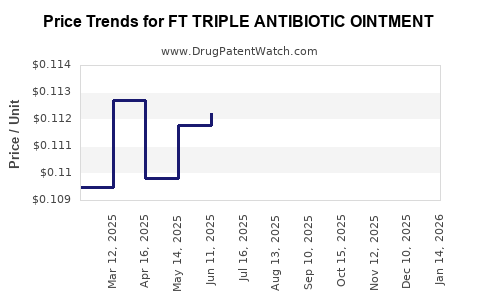
Average Pharmacy Cost for FT TRIPLE ANTIBIOTIC OINTMENT
| Drug Name | NDC | Price/Unit ($) | Unit | Date |
|---|---|---|---|---|
| FT TRIPLE ANTIBIOTIC OINTMENT | 70677-1217-01 | 0.10817 | GM | 2025-11-19 |
| FT TRIPLE ANTIBIOTIC OINTMENT | 70677-1217-01 | 0.10389 | GM | 2025-10-22 |
| FT TRIPLE ANTIBIOTIC OINTMENT | 70677-1217-01 | 0.10607 | GM | 2025-09-17 |
| FT TRIPLE ANTIBIOTIC OINTMENT | 70677-1217-01 | 0.11085 | GM | 2025-08-20 |
| FT TRIPLE ANTIBIOTIC OINTMENT | 70677-1217-01 | 0.11499 | GM | 2025-07-23 |
| FT TRIPLE ANTIBIOTIC OINTMENT | 70677-1217-01 | 0.11224 | GM | 2025-06-18 |
| FT TRIPLE ANTIBIOTIC OINTMENT | 70677-1217-01 | 0.11179 | GM | 2025-05-21 |
| >Drug Name | >NDC | >Price/Unit ($) | >Unit | >Date |
Market Analysis and Price Projections for FT Triple Antibiotic Ointment
Introduction
FT Triple Antibiotic Ointment, a topical formulation combining three antibiotics—bacitracin, neomycin, and polymyxin B—is widely used in wound care to prevent infections. Its global market dynamics, driven by increasing skin injuries, chronic wounds, and postoperative care, are shaping favorable growth prospects. This comprehensive analysis evaluates current market conditions, competitive landscape, regulatory factors, and forecasts regarding pricing trends to inform industry stakeholders.
Market Overview
The global antibiotic ointments market, including FT Triple Antibiotic Ointment, is projected to reach approximately USD 2.8 billion by 2027, expanding at a compound annual growth rate (CAGR) of around 3.5% from 2023 to 2027 [[1]]. The growth stems from rising incidences of skin injuries, diabetic ulcers, and surgical procedures, especially in developing economies. The increasing adoption of topical antibiotics as first-line treatments, coupled with a shift toward outpatient wound management, underpins this upward trajectory.
Key Market Drivers
- Rising Incidence of Skin and Wound Infections: The World Health Organization reports a surge in wound-related infections globally, propelled by factors like diabetes mellitus and aging populations [[2]].
- Growing Preference for Topical Antibiotics: Topical applications are preferred for localized treatment, reducing systemic side effects and resistance development.
- Advancements in Wound Care Technologies: Enhanced formulations offering better skin penetration and stability are expanding market reach.
- Regulatory Approvals and Product Innovations: Continuous approvals and innovations bolster product availability and trust.
Competitive Landscape
Major pharmaceutical companies dominate the FT Triple Antibiotic Ointment segment. Key players include:
- Johnson & Johnson (DermaVate™, Neosporin™): Leading market share with extensive distribution networks.
- GlaxoSmithKline (GSK): Known for high-quality topicals and global reach.
- Pfizer: Focused on wound care solutions.
- Sagent Pharmaceuticals and Others: Regional players expanding presence.
Market differentiation often hinges on formulation convenience, preservative measures, and innovative combo therapies.
Regulatory Environment
In North America and Europe, regulatory agencies like the FDA and EMA impose stringent requirements for topical antibiotics, emphasizing safety, efficacy, and resistance mitigation. These regulations influence market entry costs and timelines, affecting pricing strategies. Emerging markets often have less rigid but rapidly evolving regulatory frameworks, impacting product accessibility and pricing.
Market Challenges
- Antibiotic Resistance: Rising concerns over resistance threaten long-term usage and market sustainability. Regulatory agencies may impose restrictions, increasing R&D costs.
- Generic Competition: Patent expirations and the rise of generics exert downward pressure on prices.
- Price Sensitivity: Especially in low-income regions, cost considerations heavily influence purchasing decisions.
- Potential Side Effects: Allergic reactions and resistance risks necessitate careful formulation and marketing strategies.
Price Factors and Trends
Currently, the retail price of FT Triple Antibiotic Ointment varies substantially across geographies:
- United States: Approximate retail price ranges from USD 8 to USD 12 for a 15g tube, largely influenced by brand reputation and formulation specifics.
- Europe: Similar price points with slight variation based on healthcare policies.
- Emerging Markets: Prices often fall between USD 3 and USD 7, driven by market competition and procurement channels.
Pricing drivers include:
- Manufacturing Costs: Ingredient sourcing, quality assurance, and regulatory compliance influence costs.
- Market Penetration Strategies: Companies adopting aggressive pricing tactics in emerging markets aim to expand customer base.
- Supply Chain Dynamics: Logistics, tariffs, and import duties impact final consumer prices.
- Brand Positioning: Premium brands command higher prices; generic formulations focus on affordability.
Over the next five years, prices are projected to exhibit a gradual decline, averaging a compound reduction rate of 1-2% annually, owing to escalating generic competition and price sensitivity.
Forecasting Price Trajectories (2023–2028)
Base Scenario: With market maturation and increased generic competition, the average retail price of FT Triple Antibiotic Ointment is expected to decline marginally, settling around USD 7.50–USD 9.00 per 15g tube globally by 2028.
Optimistic Scenario: If innovations, such as sustained-release formulations or enhanced absorption properties, command premium pricing, the market could sustain higher price points, at USD 10–USD 12, especially in developed markets.
Pessimistic Scenario: Regulatory hurdles or resistance-related treatment shifts could dampen demand, leading to more aggressive discounting, possibly reducing prices below USD 6.00 in certain regions.
Pricing Power Distribution: Pharmaceutical brands with established credibility and robust R&D pipelines will retain higher pricing power, whereas local generics will continue to offer low-cost alternatives.
Strategic Implications for Stakeholders
- Manufacturers: Should prioritize innovation and compliance to sustain premium pricing and market share. Cost optimization through supply chain efficiencies will allow competitive pricing in cost-sensitive segments.
- Retailers and Distributors: Need to balance inventory costs with market demand; strategic stocking in high-growth regions can optimize margins.
- Investors: Favorable market growth, coupled with competitive pricing trends, offers stable revenue opportunities, especially for established players with strong distribution channels.
- Regulatory Bodies: Encouraging balanced policies can support affordable access while maintaining safety standards.
Key Takeaways
- The global FT Triple Antibiotic Ointment market is set to grow steadily, driven by rising skin injuries and wound management needs.
- Price projections indicate a slight decline over five years, influenced heavily by generic competition and regional economic factors.
- Innovation in formulation and strategic patent management are vital for maintaining pricing power.
- Future market success hinges on balancing regulatory compliance, resistance mitigation, and affordability.
- Stakeholders should align their strategies with regional market dynamics, considering both growth potential and pricing pressures.
FAQs
1. What are the primary factors driving the demand for FT Triple Antibiotic Ointment?
The demand is primarily driven by increasing prevalence of skin infections, chronic wounds, and postoperative wounds. The shift toward outpatient wound care and preference for topical antibiotics also contribute significantly.
2. How does antibiotic resistance impact the market for FT Triple Antibiotic Ointment?
Rising resistance can lead to reduced efficacy, prompting regulatory agencies to impose restrictions and encouraging the development of alternative therapies, thereby potentially decreasing market size and influencing pricing strategies.
3. What regions offer the most significant growth opportunities?
Emerging markets in Asia-Pacific and Latin America present considerable growth opportunities due to increasing healthcare infrastructure and demand for affordable wound care solutions.
4. How do regulatory constraints influence pricing strategies?
Strict regulations can increase R&D costs and delay product launches, impacting pricing. Conversely, less regulated markets may see more aggressive pricing and quicker product adoption.
5. Will the price of FT Triple Antibiotic Ointment decrease significantly in the future?
While overall prices are expected to decline marginally due to competition and generics, innovation and brand positioning can sustain higher price points in developed markets.
References
[1] MarketsandMarkets. "Antibiotics Market By Type, Application, and Region – Global Forecast to 2027." 2022.
[2] World Health Organization. "Global antimicrobial resistance surveillance system (GLASS) report." 2022.
More… ↓