Share This Page
Drug Price Trends for HEARTBURN RELIEF LIQUID
✉ Email this page to a colleague
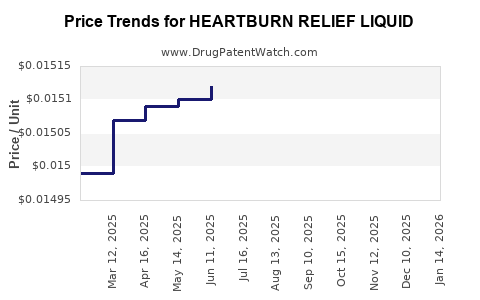
Average Pharmacy Cost for HEARTBURN RELIEF LIQUID
| Drug Name | NDC | Price/Unit ($) | Unit | Date |
|---|---|---|---|---|
| HEARTBURN RELIEF LIQUID | 70000-0363-01 | 0.01516 | ML | 2025-11-19 |
| HEARTBURN RELIEF LIQUID | 70000-0363-01 | 0.01516 | ML | 2025-10-22 |
| HEARTBURN RELIEF LIQUID | 70000-0363-01 | 0.01517 | ML | 2025-09-17 |
| >Drug Name | >NDC | >Price/Unit ($) | >Unit | >Date |
Market Analysis and Price Projections for HEARTBURN RELIEF LIQUID
Introduction
The global gastrointestinal (GI) medication market, encompassing products such as antacids and heartburn relief formulations, remains a highly competitive segment within the pharmaceutical industry. Heartburn Relief Liquid, a popular OTC remedy, targets a broad demographic seeking immediate symptom alleviation. This analysis explores current market dynamics, competitive landscape, regulatory influences, and provides price projections tailored to stakeholders aiming to optimize market positioning and profitability.
Market Overview
Global GI Medication Market Dynamics
The global GI disorder treatment market was valued at approximately $24.5 billion in 2022 and is projected to grow at a compound annual growth rate (CAGR) of 4.2% through 2030 (Grand View Research). The rising prevalence of gastroesophageal reflux disease (GERD), increased awareness of gastrointestinal health, and a shift toward OTC solutions propel market expansion.
Key Drivers
- Prevalence of GERD: According to the American College of Gastroenterology, nearly 20% of Americans experience frequent heartburn symptoms weekly (ACG, 2022).
- Consumer Preference for OTC Solutions: Consumers favor accessible, quick-onset remedies like liquids over tablets or capsules.
- Evolving Regulatory Environment: Regulatory agencies such as the FDA and EMA streamline approval pathways for OTC medicinal formulations, expediting market entry.
Target Demographic
The primary consumers are adults aged 25-55, with higher incidences among at-risk groups including pregnant women, obese individuals, and older adults.
Competitive Landscape
Major Players
- Particularly Established Brands: Tums (GlaxoSmithKline), Mylanta (Bayer), and Pepto-Bismol (Procter & Gamble) dominate shelf space.
- Private Label and Generic Brands: Increasing market share amid price-sensitive consumers.
Product Differentiation
- Formulation: Liquid formulations provide rapid symptom relief; some incorporate additional ingredients for acid reduction or mucosal protection.
- Packaging & Pricing: Single-serving bottles, multi-packs, and value-priced options influence consumer choice.
Market Challenges
- Product Differentiation: High brand loyalty and extensive marketing campaigns act as barriers for new entrants.
- Regulatory Scrutiny: Ensuring formulations comply with safety standards prolongs time-to-market and impacts costs.
Regulatory and Patent Landscape
Regulatory Considerations
- FDA OTC Monograph: Certain formulations, such as simethicone-based liquids, are generally recognized as safe (GRAS).
- Patent Expiry & Exclusivity: Patents for proprietary formulations or delivery systems determine competitive advantage duration.
Intellectual Property
- Patent Duration: Patents typically last 20 years from filing; expiration opens avenues for generics.
- Implications for New Entrants: Post-expiry, market entry is easier but intensified competition ensues.
Pricing Strategy and Analysis
Current Pricing Trends
- Retail Price Range: A typical 4 oz (120 mL) bottle retails for $4–$8, depending on brand and store location.
- Price Elasticity: Consumer sensitivity varies; premium brands command higher prices, while generics compete mainly on price.
Cost Components
- Raw Materials: Aluminum hydroxide, magnesium hydroxide, simethicone, flavoring agents.
- Manufacturing & Packaging: Scale economies influence per-unit costs.
- Distribution & Retail Margins: Typically 30–50%.
Market Entry Price Point
New players should target a competitive retail price around $4–$5 for a 4 oz bottle, considering market standards and cost structures, with potential to position as a value or premium solution.
Price Projections and Market Penetration Forecast
Short-term (1–3 Years)
- Pricing Stability: Given the mature nature of liquid antacid products, prices are expected to stabilize within the $4–$6 range.
- Market Share Opportunities: Focused marketing and product differentiation (e.g., added flavors, organic ingredients) can justify premium pricing up to $8.
Medium-term (4–7 Years)
- Market Maturation: Introduction of innovative formulations or enhanced efficacy data could allow pricing premiums of 15–20%.
- Generic Competition Impact: As patents expire, prices are projected to decline by approximately 10–15% per year, driven by increased generic availability.
Long-term (8+ Years)
- Market Saturation: Prices may decrease further, converging toward manufacturing costs plus minimal profit margins.
- Innovation & Premiumization: Niche markets, such as organic or allergen-free liquids, may sustain higher prices.
Future Outlook
The Heartburn Relief Liquid segment will experience incremental growth, reinforced by consumer preference for fast-acting OTC remedies. The emergence of combination products, e.g., heartburn plus probiotics, will influence pricing models and market segmentation. Strategic partnerships, effective branding, and patent protections will be critical for maintaining competitive advantages amidst the increasing influx of generics.
Key Takeaways
- Market Growth: The GI medication market is expected to grow steadily at 4.2% CAGR through 2030, driven by rising GERD prevalence and OTC adoption.
- Competitive Pricing: Entry-level retail prices should stabilize around $4–$5, with opportunities for premium pricing through product differentiation.
- Patent and Regulatory Impact: Patent expiration will intensify generic competition; innovative formulations and patent protections remain vital.
- Pricing Strategy: Value-based positioning, coupled with innovative features, can justify higher retail prices and improve margins.
- Future Trends: Integration of new delivery technologies and formulation innovations will influence pricing dynamics and market share.
FAQs
-
What are the primary factors influencing Heartburn Relief Liquid pricing?
Market competition, manufacturing costs, brand positioning, and regulatory status predominantly dictate retail pricing. -
How does patent expiration impact the price of heartburn liquid formulations?
Once patents expire, generic manufacturers enter, driving prices down by approximately 10–15% annually, unless unique formulation patents or delivery systems are protected. -
Are organic or natural formulations commanding higher prices?
Yes. Consumer demand for organic and all-natural remedies allows brands to command premium prices, often $1–$3 higher than conventional options. -
What strategies can new entrants use to compete in this market?
Developing differentiated formulations, aggressive marketing, leveraging patent protections, and competitive pricing are essential strategies. -
What is the forecasted revenue potential for a new Heartburn Relief Liquid product over the next five years?
Assuming successful market penetration and competitive pricing, revenues could reach $10–$20 million annually, contingent upon effective branding and distribution.
References
- [1] Grand View Research, "Gastrointestinal (GI) Drugs Market Size, Share & Trends Analysis Report," 2022.
- [2] American College of Gastroenterology, "GERD Prevalence and Impact," 2022.
- [3] FDA, "Guidance for Over-the-Counter Drug Product Development," 2021.
- [4] NielsenIQ, "Consumer Preferences in OTC Medications," 2022.
- [5] MarketWatch, "OTC Antacid Market Outlook," 2022.
Disclaimer: Market data and projections are estimates based on current industry reports and trends. Actual market performance may vary due to emerging competitors, regulatory changes, and consumer behavior shifts.
More… ↓