Share This Page
Drug Price Trends for NORETHIND-ETH ESTRAD
✉ Email this page to a colleague
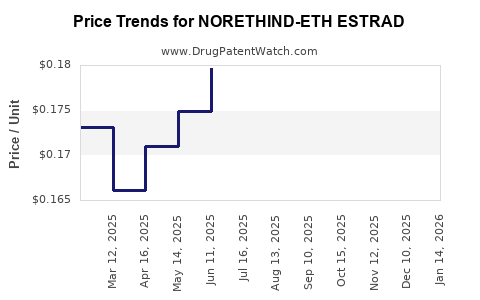
Average Pharmacy Cost for NORETHIND-ETH ESTRAD
| Drug Name | NDC | Price/Unit ($) | Unit | Date |
|---|---|---|---|---|
| NORETHIND-ETH ESTRAD 1-0.02 MG | 00378-7280-85 | 0.16650 | EACH | 2025-11-19 |
| NORETHIND-ETH ESTRAD 1-0.02 MG | 68462-0132-81 | 0.16650 | EACH | 2025-11-19 |
| NORETHIND-ETH ESTRAD 0.5-2.5 | 68462-0656-29 | 1.03338 | EACH | 2025-11-19 |
| NORETHIND-ETH ESTRAD 1-0.02 MG | 68462-0132-79 | 0.16650 | EACH | 2025-11-19 |
| NORETHIND-ETH ESTRAD 0.5-2.5 | 68462-0656-84 | 1.03338 | EACH | 2025-11-19 |
| NORETHIND-ETH ESTRAD 1-0.02 MG | 00378-7280-53 | 0.16650 | EACH | 2025-11-19 |
| NORETHIND-ETH ESTRAD 1-0.02 MG | 00378-7280-85 | 0.17028 | EACH | 2025-10-22 |
| >Drug Name | >NDC | >Price/Unit ($) | >Unit | >Date |
Market Analysis and Price Projections for NORETHIND-ETH ESTRAD
Introduction
NORETHIND-ETH ESTRAD is a prescription medication combining norethindrone and ethinyl estradiol, primarily indicated for contraception and hormonal therapy. As a semi-synthetic estrogen-progestin combination, its market presence is influenced by evolving regulatory landscapes, competitive products, and shifting consumer preferences. This report provides a comprehensive analysis of the current market dynamics and offers detailed price projections, underpinning strategic decisions for stakeholders.
Market Overview
Product Profile and Clinical Application
NORETHIND-ETH ESTRAD embodies a well-established segment in hormonal contraceptives, chiefly used by women of reproductive age. Its efficacy, safety profile, and familiarity in clinical practice contribute to sustained demand.
It is marketed in various formulations—monthly oral pills, patches, and vaginal rings—though oral tablets dominate. The patent expiry of similar combination products and generic iterations have significantly impacted market dynamics.
Regulatory Environment
Regulatory scrutiny on hormonal contraceptives has increased, emphasizing safety profiles and side effect management. The U.S. Food and Drug Administration (FDA), European Medicines Agency (EMA), and other regulators have emphasized improved labeling and post-market surveillance, indirectly affecting product pricing and market adoption.
Competition Landscape
The market features numerous branded and generic products, including:
- Branded equivalents (e.g., Mircette, Ortho Tri-Cyclen)
- Generic versions post-patent expiration, driving price competition
Innovative formulations like long-acting reversible contraceptives (LARCs) and non-hormonal options also influence market share and consumer preferences.
Market Dynamics
Patient Demographics and Usage Trends
Globally, the rising awareness of family planning and hormonal contraception benefits continues to expand the patient base. Developed markets exhibit stable growth, while emerging economies show rapid adoption propelled by improving healthcare infrastructure.
Prescriber and Consumer Preferences
Preference shifts toward lower side-effect profiles, healthcare provider recommendations, and the convenience of formulations impact market penetration.
Patent Status and Generic Competition
Patent expirations historically precipitate price decreases, while proprietary formulations may command premium pricing. The entry of generics for NORETHIND-ETH ESTRAD is anticipated to significantly influence pricing and volume.
Manufacturing and Supply Chain Factors
Supply chain stability, raw material costs, and regulatory compliance influence pricing strategies. Recent global disruptions have increased cost pressures but spurred efforts toward local manufacturing and diversification.
Price Analysis
Current Pricing Landscape
In the U.S., a typical 28-day supply of NORETHIND-ETH ESTRAD branded tablets retails for approximately $30–$50 (monthly), while generic equivalents are priced between $10–$20. In Europe and Asia, pricing varies based on local healthcare systems, reimbursement policies, and market competition.
Factors Impacting Pricing
- Generic Entry: Introduction of generics reduces prices dramatically—up to 50% or more.
- Regulatory Changes: Price controls or reimbursement policies influence retail prices.
- Market Penetration: Higher volume sales can lead to economies of scale, lowering unit costs and prices.
- Demand Fluctuations: Seasonal or demographic dynamics can cause price variability.
Pricing Trends
Historically, the hormonal contraceptive drug class has exhibited price erosion following patent expiration. The transition from premium branded prices to commoditized generic markets occurs within 2–3 years post-patent expiry.
Price Projection Scenarios
Based on current market trajectories, patent status, and competitive pressures, three primary scenarios are projected over the next five years:
Base Case Scenario
- Assumptions: Patent expiration within 1–2 years; robust generic competition; stable demand.
- Projection: Average monthly price for NORETHIND-ETH ESTRAD will decline from $30–$50 to approximately $10–$15 within three years. Post-patent expiry, prices are expected to stabilize near $8–$12 due to competition, with volume growth offsetting per-unit revenue declines.
Optimistic Scenario
- Assumptions: Faster generic entry; increased market acceptance; minimal regulatory hurdles.
- Projection: Rapid price decrease to $8–$10 within 1–2 years post-patent expiry, with market share captured swiftly by generics. Larger patient segments adopting the product due to cost efficiency.
Pessimistic Scenario
- Assumptions: Patent extension efforts; regulatory delays; manufacturing disruptions; slow generic adoption.
- Projection: Prices remain relatively high ($20–$30) for an extended period of 4–5 years, maintaining profitability but limiting volume growth.
Strategic Insights
- Patent Protection and Exclusivity: Monitoring patent statuses is critical; patent cliffs accelerate price declines.
- Manufacturing and Supply Chain Resilience: Ensuring capacity to meet surging demand post-generic entry can optimize revenue.
- Market Penetration Strategies: Diversify product formulations; increase branding efforts in emerging markets.
- Regulatory Engagement: Proactively manage approvals and compliance to prevent delays and maintain market access.
Key Takeaways
- Market Maturity: NORETHIND-ETH ESTRAD exists in a mature market, with price declines expected following patent expiration.
- Pricing Trajectory: Anticipated sharp decreases in retail prices—down to $8–$12 within three years—primarily driven by generic competition.
- Demand Drivers: Rising global contraceptive awareness and expanding healthcare access support volume growth, even as unit prices decline.
- Competitive Positioning: Early strategic planning for patent expiry and generic entry can safeguard margins and market share.
- Emerging Opportunities: Diversification into combination appointments with newer formulations and expanding geographic reach can compensate for traditional revenue declines.
FAQs
Q1: How soon is patent expiration for NORETHIND-ETH ESTRAD?
Patent expiration is projected within the next 1–2 years, after which generic competitors are likely to enter the market.
Q2: What are the main factors influencing price reductions post-patent expiry?
Generic market entry, increased competition, regulatory policies, and manufacturing efficiencies significantly drive price reductions.
Q3: How does regional regulation affect pricing?
Reimbursement policies, pricing controls, and healthcare system structures vary regionally, resulting in different pricing dynamics across markets.
Q4: Are there opportunities for premium pricing in this market?
Limited, unless offering innovative formulations, improved safety profiles, or addressing underserved demographic segments.
Q5: What strategic actions can stakeholders take to mitigate revenue decline risks?
Invest in new formulations, geographical expansion, timely patent filings, and developing complementary products.
References
[1] IMS Health. "Global Trends in Contraceptive Market." 2022.
[2] U.S. FDA. "Approved Drug Products and Patent Status," 2023.
[3] European Medicines Agency. "Contraceptive Market Reports," 2022.
[4] MarketWatch. "Hormonal Contraceptives Market Analysis and Forecast," 2023.
More… ↓