BUDESONIDE - Generic Drug Details
✉ Email this page to a colleague
What are the generic sources for budesonide and what is the scope of freedom to operate?
Budesonide
is the generic ingredient in fifteen branded drugs marketed by Padagis Israel, Salix, Astrazeneca, Amneal Pharms, Aurobindo Pharma Usa, Barr Labs Div Teva, Dr Reddys Labs Sa, Natco, Rising, Sciecure Pharma Inc, Zydus Pharms, Padagis Us, Sun Pharm Inds Inc, Calliditas, Cheplapharm, Apotex, Kenvue Brands, Cipla, Eugia Pharma, Impax Labs Inc, Lupin, Nephron, Sandoz, Sun Pharm, Teva Pharms, Teva Pharms Usa, Takeda Pharms Usa, Actavis Labs Fl Inc, Mylan, and Astrazeneca Ab, and is included in thirty-six NDAs. There are thirty-three patents protecting this compound and five Paragraph IV challenges. Additional information is available in the individual branded drug profile pages.Budesonide has one hundred and sixty-one patent family members in thirty-three countries.
There are twenty-two drug master file entries for budesonide. Forty-three suppliers are listed for this compound.
Summary for BUDESONIDE
| International Patents: | 161 |
| US Patents: | 33 |
| Tradenames: | 15 |
| Applicants: | 30 |
| NDAs: | 36 |
| Drug Master File Entries: | 22 |
| Finished Product Suppliers / Packagers: | 43 |
| Raw Ingredient (Bulk) Api Vendors: | 1 |
| Clinical Trials: | 470 |
| Patent Applications: | 8,067 |
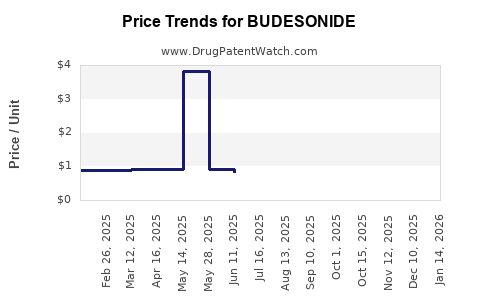
| Drug Prices: | Drug price trends for BUDESONIDE |
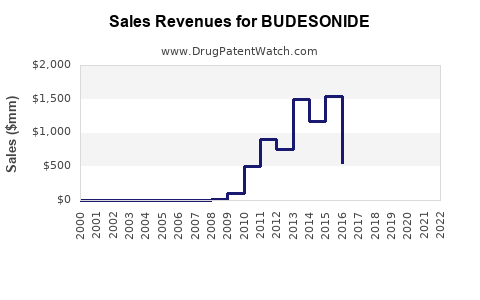
| Drug Sales Revenues: | Drug sales revenues for BUDESONIDE |
| Patent Litigation and PTAB cases: | See patent lawsuits and PTAB cases for BUDESONIDE |
| What excipients (inactive ingredients) are in BUDESONIDE? | BUDESONIDE excipients list |
| DailyMed Link: | BUDESONIDE at DailyMed |
Recent Clinical Trials for BUDESONIDE
Identify potential brand extensions & 505(b)(2) entrants
| Sponsor | Phase |
|---|---|
| University of Wisconsin, Madison | PHASE2 |
| Meriter Foundation | PHASE2 |
| AHS Cancer Control Alberta | PHASE2 |
Pharmacology for BUDESONIDE
| Drug Class | Corticosteroid |
| Mechanism of Action | Corticosteroid Hormone Receptor Agonists |
Medical Subject Heading (MeSH) Categories for BUDESONIDE
Anatomical Therapeutic Chemical (ATC) Classes for BUDESONIDE
Paragraph IV (Patent) Challenges for BUDESONIDE
| Tradename | Dosage | Ingredient | Strength | NDA | ANDAs Submitted | Submissiondate |
|---|---|---|---|---|---|---|
| EOHILIA | Oral Suspension | budesonide | 2 mg/10 mL | 213976 | 1 | 2025-03-31 |
| TARPEYO | Delayed-release Capsules | budesonide | 4 mg | 215935 | 1 | 2024-12-26 |
| UCERIS | Extended-release Tablets | budesonide | 9 mg | 203634 | 1 | 2013-03-11 |
| PULMICORT RESPULES | Inhalation Suspension | budesonide | 1 mg/2 mL | 020929 | 1 | 2010-05-28 |
| ENTOCORT EC | Enteric Coated Capsules | budesonide | 3 mg | 021324 | 1 | 2008-02-01 |
| RHINOCORT ALLERGY | Nasal Spray | budesonide | 0.032 mg (32 mcg)/spray | 020746 | 1 | 2007-05-14 |
| PULMICORT RESPULES | Inhalation Suspension | budesonide | 0.25 mg/2 mL and 0.5 mg/2 mL | 020929 | 1 | 2005-09-15 |
US Patents and Regulatory Information for BUDESONIDE
| Applicant | Tradename | Generic Name | Dosage | NDA | Approval Date | TE | Type | RLD | RS | Patent No. | Patent Expiration | Product | Substance | Delist Req. | Exclusivity Expiration |
|---|---|---|---|---|---|---|---|---|---|---|---|---|---|---|---|
| Padagis Us | ENTOCORT EC | budesonide | CAPSULE, DELAYED RELEASE;ORAL | 021324-001 | Oct 2, 2001 | AB | RX | Yes | Yes | ⤷ Get Started Free | ⤷ Get Started Free | ⤷ Get Started Free | |||
| Astrazeneca Ab | BREZTRI AEROSPHERE | budesonide; formoterol fumarate; glycopyrrolate | AEROSOL, METERED;INHALATION | 212122-001 | Jul 23, 2020 | RX | Yes | Yes | 9,415,009 | ⤷ Get Started Free | ⤷ Get Started Free | ||||
| Astrazeneca Ab | BREZTRI AEROSPHERE | budesonide; formoterol fumarate; glycopyrrolate | AEROSOL, METERED;INHALATION | 212122-001 | Jul 23, 2020 | RX | Yes | Yes | 10,716,753 | ⤷ Get Started Free | Y | ⤷ Get Started Free | |||
| Takeda Pharms Usa | EOHILIA | budesonide | SUSPENSION;ORAL | 213976-001 | Feb 9, 2024 | RX | Yes | Yes | ⤷ Get Started Free | ⤷ Get Started Free | ⤷ Get Started Free | ||||
| Calliditas | TARPEYO | budesonide | CAPSULE, DELAYED RELEASE;ORAL | 215935-001 | Dec 15, 2021 | RX | Yes | Yes | 11,896,719 | ⤷ Get Started Free | ⤷ Get Started Free | ||||
| >Applicant | >Tradename | >Generic Name | >Dosage | >NDA | >Approval Date | >TE | >Type | >RLD | >RS | >Patent No. | >Patent Expiration | >Product | >Substance | >Delist Req. | >Exclusivity Expiration |
Expired US Patents for BUDESONIDE
| Applicant | Tradename | Generic Name | Dosage | NDA | Approval Date | Patent No. | Patent Expiration |
|---|---|---|---|---|---|---|---|
| Cheplapharm | PULMICORT FLEXHALER | budesonide | POWDER, METERED;INHALATION | 021949-002 | Jul 12, 2006 | 7,143,764 | ⤷ Get Started Free |
| Cheplapharm | PULMICORT FLEXHALER | budesonide | POWDER, METERED;INHALATION | 021949-002 | Jul 12, 2006 | 6,142,145 | ⤷ Get Started Free |
| Astrazeneca | PULMICORT | budesonide | POWDER, METERED;INHALATION | 020441-003 | Jun 24, 1997 | 4,524,769 | ⤷ Get Started Free |
| Astrazeneca | PULMICORT RESPULES | budesonide | SUSPENSION;INHALATION | 020929-001 | Aug 8, 2000 | 6,598,603*PED | ⤷ Get Started Free |
| Salix | UCERIS | budesonide | TABLET, EXTENDED RELEASE;ORAL | 203634-001 | Jan 14, 2013 | 7,410,651 | ⤷ Get Started Free |
| >Applicant | >Tradename | >Generic Name | >Dosage | >NDA | >Approval Date | >Patent No. | >Patent Expiration |
EU/EMA Drug Approvals for BUDESONIDE
| Company | Drugname | Inn | Product Number / Indication | Status | Generic | Biosimilar | Orphan | Marketing Authorisation | Marketing Refusal |
|---|---|---|---|---|---|---|---|---|---|
| Dr. Falk Pharma GmbH | Jorveza | budesonide | EMEA/H/C/004655Jorveza is indicated for the treatment of eosinophilic esophagitis (EoE) in adults (older than 18 years of age). | Authorised | no | no | yes | 2018-01-08 | |
| Stada Arzneimittel AG | Kinpeygo | budesonide | EMEA/H/C/005653Kinpeygo is indicated for the treatment of primary immunoglobulin A (IgA) nephropathy (IgAN) in adults at risk of rapid disease progression with a urine protein-to-creatinine ratio (UPCR) ≥1.5 g/gram. | Authorised | no | no | yes | 2022-07-15 | |
| >Company | >Drugname | >Inn | >Product Number / Indication | >Status | >Generic | >Biosimilar | >Orphan | >Marketing Authorisation | >Marketing Refusal |
International Patents for BUDESONIDE
| Country | Patent Number | Title | Estimated Expiration |
|---|---|---|---|
| China | 120053463 | 用于治疗IgA肾病的包含布地奈德的药物组合物 (Pharmaceutical composition comprising budesonide for treating IgA nephropathy) | ⤷ Get Started Free |
| Colombia | 2024009565 | Composición farmacéutica que comprende budesonida para tratamiento de la nefropatía iga | ⤷ Get Started Free |
| Hungary | E051538 | ⤷ Get Started Free | |
| Slovenia | 3354276 | ⤷ Get Started Free | |
| World Intellectual Property Organization (WIPO) | 2009064417 | ⤷ Get Started Free | |
| >Country | >Patent Number | >Title | >Estimated Expiration |
Supplementary Protection Certificates for BUDESONIDE
| Patent Number | Supplementary Protection Certificate | SPC Country | SPC Expiration | SPC Description |
|---|---|---|---|---|
| 2435024 | 301102 | Netherlands | ⤷ Get Started Free | PRODUCT NAME: COMBINATIE VAN FORMOTEROL (MET INBEGRIP VAN DE FARMACEUTISCH AANVAARDBARE ZOUTEN, ESTERS, SOLVATEN OF ENANTIOMEREN ERVAN), GLYCOPYRROLAAT (MET INBEGRIP VAN DE FARMACEUTISCH AANVAARDBARE ZOUTEN, ESTERS, SOLVATEN OF ENANTIOMEREN ERVAN) EN BUDESONIDE (MET INBEGRIP VAN DE FARMACEUTISCH AANVAARDBARE ZOUTEN, ESTERS, SOLVATEN OF ENANTIOMEREN ERVAN); REGISTRATION NO/DATE: EU/1/20/1498 20201210 |
| 2435024 | 2021C/518 | Belgium | ⤷ Get Started Free | PRODUCT NAME: UNE COMBINAISON DE FORMOTEROL (Y COMPRIS TOUS SES SELS, ESTERS, SOLVATES OU ENANTIOMERES PHARMACEUTIQUEMENT ACCEPTABLES), GLYCOPYRROLATE (Y COMPRIS TOUS SES SELS, ESTERS, SOLVATES OU ENANTIOMERES PHARMACEUTIQUEMENT ACCEPTABLES) ET BUDESONIDE (Y COMPRIS TOUS SES SELS, ESTERS, SOLVATES OU ENANTIOMERES PHARMACEUTIQUEMENT ACCEPTABLES); AUTHORISATION NUMBER AND DATE: EU/1/20/1498 20201210 |
| 2435024 | SPC/GB21/029 | United Kingdom | ⤷ Get Started Free | PRODUCT NAME: A COMBINATION OF FORMOTEROL, INCLUDING PHARMACEUTICALLY ACCEPTABLE SALTS, ESTERS AND SOLVATES THEREOF, GLYCOPYRROLATE, INCLUDING PHARMACEUTICALLY ACCEPTABLE SALTS, ESTERS AND SOLVATES THEREOF, AND BUDESONIDE INCLUDING PHARMACEUTICALLY ACCEPTABLE SALTS, ES; REGISTERED: UK EU/1/20/1498 (NI) 20201210; UK PLGB 17901/0352-001 20201210 |
| 2435024 | 2190014-7 | Sweden | ⤷ Get Started Free | PRODUCT NAME: A COMBINATION OF FORMOTEROL INCLUDING ANY PHARMACEUUTICALLY ACCEPTABLE SALTS, ESTERS, OR SOLVATES THEREOF, GLYCOPYRROLATE INCLUDING ANY PHARMACEUTICALLY ACCEPTABLE SALTS, ESTERS, OR SOLVATES THEREOF, AND BUDESONIDE INCLUDING ANY PHARMACEUTICALLY ACCEPTABLE SALT, ESTERS ORSOLVATES THEREOF; REG. NO/DATE: EU/1/20/1498 20201210 |
| 2435024 | 132021000000095 | Italy | ⤷ Get Started Free | PRODUCT NAME: UNA COMBINAZIONE DI FORMOTEROLO (INCLUSI SUOI SALI, ESTERI, SOLVATI O ENANTIOMERI FARMACEUTICAMENTE ACCETTABILI), GLICOPIRROLATO (INCLUSI SUOI SALI, ESTERI, SOLVATI O ENANTIOMERI FARMACEUTICAMENTE ACCETTABILI) E BUDESONIDE (INCLUSI SUOI SALI, ESTERI, SOLVATI O ENANTIOMERI FARMACEUTICAMENTE ACCETTABILI)(TRIXEO AEROSPHERE); AUTHORISATION NUMBER(S) AND DATE(S): EU/1/20/1498, 20201210 |
| >Patent Number | >Supplementary Protection Certificate | >SPC Country | >SPC Expiration | >SPC Description |
Market Dynamics and Financial Trajectory for BUDESONIDE
More… ↓
Make Better Decisions: Try a trial or see plans & pricing
Drugs may be covered by multiple patents or regulatory protections. All trademarks and applicant names are the property of their respective owners or licensors. Although great care is taken in the proper and correct provision of this service, thinkBiotech LLC does not accept any responsibility for possible consequences of errors or omissions in the provided data. The data presented herein is for information purposes only. There is no warranty that the data contained herein is error free. We do not provide individual investment advice. This service is not registered with any financial regulatory agency. The information we publish is educational only and based on our opinions plus our models. By using DrugPatentWatch you acknowledge that we do not provide personalized recommendations or advice. thinkBiotech performs no independent verification of facts as provided by public sources nor are attempts made to provide legal or investing advice. Any reliance on data provided herein is done solely at the discretion of the user. Users of this service are advised to seek professional advice and independent confirmation before considering acting on any of the provided information. thinkBiotech LLC reserves the right to amend, extend or withdraw any part or all of the offered service without notice.
ISSN: 2162-2639

Privacy and Cookies
Terms & Conditions
Site Map
DrugPatentWatch Alternatives
LOE / Major Patent Expirations 2025 - 2026
NCE-1 Patent Challenge Dates 2025 - 2026
Friedman, Yali. "DrugPatentWatch" DrugPatentWatch, thinkBiotech, 2025, www.DrugPatentWatch.com.
See Primary Research Papers Citing DrugPatentWatch